
Argyll and Bute · Scotland
Clynder External Mastic
We cover Clynder for sealing brickwork movement joints, render, cladding and façade joints. Old material cut out, joints cleaned and sealed neatly and every job guaranteed for a year.
- Movement joints filled with mortar instead of sealant
- Joints where the bead has come unstuck
- Failed sealant between panels on a façade
How we handle external mastic in Clynder
Low-level joints can usually be done from the ground. For joints higher up, give us some details of the building and we will confirm what access is needed. If you have failed sealant between panels on a façade and hard, crazed mastic that has stopped moving, we can put it right.
In and around a place like Clynder, many buildings face open ground and take the full weather. Gutter joints and wall joints take a battering, so they need a sealant that moves with the building.
Whatever the size of the job, you get the same 12-month guarantee.
- Place
- Clynder (G84)
- Region
- Argyll and Bute
- Cover
- A year, on every job
- Quotes
- A clear price before we start
- info@mrmastic.co.uk
- Updated
- 26 October 2026
FAQs for Clynder
Will you come out to Clynder?
Yes, we do. Our work covers the whole of Scotland, from towns to the smallest places. The journey is planned ahead, so it helps to know about access.
Does the coastal weather in Clynder affect outside sealant?
Near the sea, outside joints face more wind, rain and salt than they would inland, so the choice of sealant and the preparation matter even more. Walls facing the sea are usually the first to need attention.
Can you do several jobs on one visit?
Yes, we can. Several rooms, windows or areas can go on one quote.
Can you match the colour of my brickwork?
There’s a good range of exterior colours, including greys, browns, whites and stone tones. We choose the closest to your brick or render so the joint does not draw the eye.
Do I have to be there?
Access is agreed with you when the job is booked. For inside work, that normally means someone being in.
Do you take out the old sealant first?
Yes. We cut out all the old sealant and clean the joint.
Are you insured?
Yes. Mr Mastic is fully insured, with over 20 years’ experience in sealant work.
How often do external joints need resealing?
It varies with how exposed the wall is and how much the joint moves. Signs to watch for are cracking, hardening and gaps at the edges, and reseal at that point.
Should I try it myself first?
If you are set on DIY, put the effort into preparation: take out all the old sealant, make sure the joint is clean and dry, and give it the full cure time. If it fails, we can still redo it.
Some jobs are best left to a professional: high-level joints, fire-rated gaps, external movement joints and big jobs need the right product, the right access and the right method.
What we do, step by step
There is not much for you to do on the day. Point us to the joints and we will get on with it. The job generally takes a few hours to a few days, depending on the length of joint and the access. Somewhere like Clynder may be a longer drive, and the journey is planned ahead. Tell us about tracks, gates, a ferry crossing or anything unusual about getting there.
- We look at every joint and agree a colour to suit the wall.
- Failed sealant is removed back to clean, sound faces.
- Backing rod goes in so the sealant can stretch between the two faces.
- Primer is applied wherever the sealant needs it.
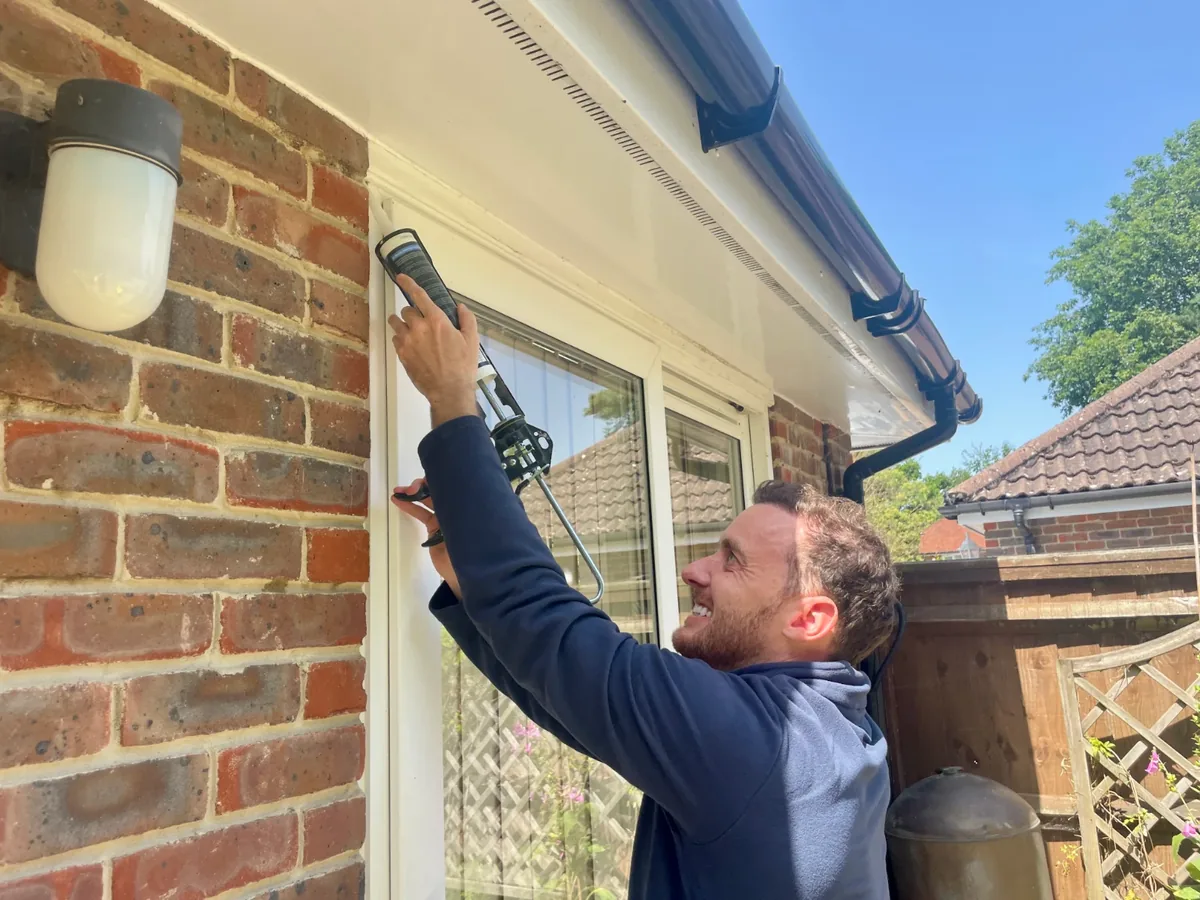
- We gun in low-modulus sealant and tool it neatly.
Getting ready for the visit
- On commercial sites, let us know about site rules
- Plan for the work area to be out of bounds to pets and children
- Let us know about parking restrictions
How to get a quote
Asking for a quote is easy: tell us what needs doing and where and its rough size. Photos by email help us understand the job, and we’ll take it from there.
Read more
How we quote for external mastic
You will get a clear quote before any work starts. It’s based on:
- Mould in or behind the old joints
- How many rooms, windows or areas are involved
- The product the joint needs
- The amount of work
Combining jobs into one visit is usually more efficient than separate visits. We will send you a clear quote for the lot.
What to tell us for a quote
When you call or email, it’s useful to know:
- If it’s domestic, commercial or a hotel
- Roughly how big the job is
- The problem you’ve noticed
- How we’d reach the joints
To get a quote, email us at info@mrmastic.co.uk and tell us where the job is and what the problem looks like. You will have a clear quote before any work starts.
Honest limits
A few problems are outside what sealant work can do:
- Walls that need new movement joints cut into them
- Loose or hollow render, which needs re-rendering
- Damp from another source, such as a leaking gutter or a bridged damp-proof course
Not sure which it is? You can drop us a line at info@mrmastic.co.uk and we will tell you honestly.
What we seal
- Copings & trims
- Joints between brick and frames
- Façade panels
- Brickwork movement joints
- Render & cladding joints
- Concrete & block
Looking after it afterwards
So the new joints stay in good condition:
- Tell anyone working on the walls about the movement joints
- Never let anyone fill a movement joint with mortar
- Keep high-pressure jets off the joints
- Ask before painting over external sealant
Don’t paint over the new sealant unless we’ve said the product is paintable. Paint can crack on a flexible joint and spoil the finish.
An open movement joint lets rain into the wall every time it pours. Over time it can mean damp inside, stained render or frost-damaged brick, all bigger jobs than a reseal.
What happens if it’s left?
Resealing a run of joints in one go is generally better than patching one at a time. Joints of the same age tend to fail together, and access only has to be arranged once. In an older home around Clynder, damp from a failed joint can get into timber and plaster.
Homes and businesses are quoted the same way: the amount of work, the access and the products needed, plus any working-time requirements on site. Ask us for a quote and we will explain what it covers.
Why us?
- Colour picked to suit the job
- Quality sealants from Arbo and Everbuild
- Full insurance on every job
- A choice of colours where the product allows
Read our cost guide and customer reviews.
Places near Clynder
Also in Clynder
Different surfaces, different methods
Copings and trims
A failed coping joint lets water into the top of the wall. Resealing them is a small job that protects a lot.
Joints between dissimilar materials
Joints where frames, sills or panels meet the wall are common leak points. The old joint is removed and a sealant that bonds to both sides goes in.
What external mastic looks like in Clynder
Clynder is close to the coast, where wind-driven rain is a fact of life and, nearer the shore, so is salt air. Both are hard on movement joints and outside wall joints, which can dry out and crack sooner where a building faces the weather. Clynder is in the west of Scotland, which is wetter than the east, so there’s plenty of rain for movement joints and outside wall joints to keep out.
Hill House, about 3.4 miles east, is one of the historic houses in the wider area around Clynder, and older homes nearby need a sealant that suits their walls. For landlords with property near Helensburgh Upper station, split movement joints are easy to miss on a rental until damp shows inside.
Clynder is about 4 miles west of Helensburgh, in Argyll and Bute. Homes, rented property, offices and hotels in Clynder can book us for external mastic, old or new, large or small. The work is guaranteed for a year. Across Argyll and Bute, we cover 118 places, Clynder among them. For nearby work, see our Glasgow page (24 miles or so).
Postcode districts we cover here for external mastic: G84. We cover properties on Pier Road, Straid Bheag and Straid-a-Cnoc. We also cover the places around Clynder: Rahane (2 miles north-west), Cove (2 miles south-west), Ardpeaton (2 miles west), Coulport (2 miles north-west) and Mambeg (3 miles north). Further out, we also cover Helensburgh (4 miles east), Dunoon (6 miles south-west), Port Bannatyne (15 miles south-west), Sandbank (6 miles south-west) and Innellan (11 miles south-west).
Local landmarks in Clynder
The closest station to Clynder is Helensburgh Upper station, roughly 3.3 miles east. Nearby you’ll also find Cove Castle (2.3 miles south-west) and Victoria Infirmary (4.1 miles east). Green spaces nearby include Lyle Hill.