
Dumfries and Galloway · Scotland
Window Mastic in Glencaple
Mastic around window and door frames, sills and patio doors for Glencaple, backed by a one-year guarantee. Ask us for a quote.
- Cracked sealant at the sill ends
- Mastic that’s falling out in pieces
- Whistling draughts around closed windows
How we handle window mastic in Glencaple
Most frames have an outside joint and an inside one. Outside, the mastic keeps rain out; the internal joint closes the gap to the plaster and stops draughts. We seal one or both, depending on what’s needed. We work on composite doors, patio & French doors and window sills, and people most often call us about old mastic that has gone black or come away and white mastic on grey or black frames.
In and around a place like Glencaple, homes range from older stone-built cottages to newer houses. Wind-driven rain finds any gap around a frame or sill, so the mastic there works hard.
The work is covered for a year after we finish. If there’s a problem with it, please email us at info@mrmastic.co.uk.
- Location
- Glencaple (DG1)
- Region
- Dumfries and Galloway
- Guarantee
- One year on every job
- Quote
- A clear quote up front
- info@mrmastic.co.uk
- Page updated
- 26 October 2026
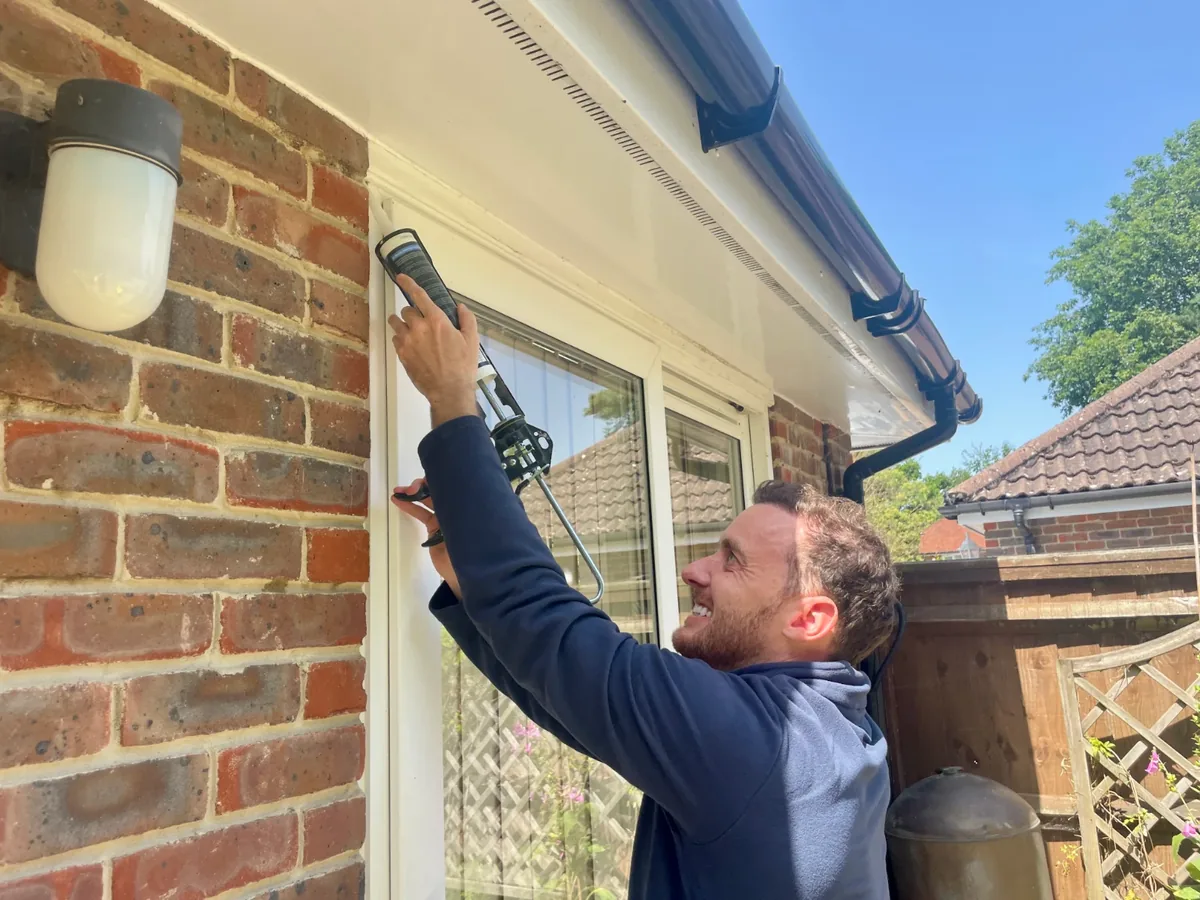
The process
At the end, we look at the finished work together. The visit itself normally takes most of a day for a typical house, less for a few frames, depending on how much there is to do. Outside jobs in Glencaple need a dry day, because sealant will not bond to a wet joint, so an outdoor job can move if the forecast changes. Indoor work goes ahead whatever the weather.
- We start by checking each window and door with you.
- We remove the old mastic and clean the frame and the wall.
- Where gaps are deep, backing rod goes in first.
- New exterior sealant goes on in a matching colour and is tooled smooth.
- Finally we tidy up and check each joint.
Before we arrive
- Move anything stored near the joints
- Tell us if parking is tricky
- Where the joints are inside, avoid wetting them before we arrive
Ask for a quote
The more we know about the job, the more useful the quote. Tell us where the job is, what’s wrong and how much there is, and add photos by email if you can.
Read more
What the job involves on each surface
uPVC windows
We clean the frame edge carefully so the plastic is not marked, then the sealant goes in between frame and wall and tooled smooth.
Composite doors
Composite doors are normally hung in an uPVC-type frame, so its perimeter joint is sealed much like a window. We match the colour to the frame.
Keeping the joints in good condition
So the new joints stay in good condition:
- Look round the frames every year or so
- Wipe condensation off the frames
- Use gentle cleaners on frames and sealant
- Paint up to the joint, not over it
Timber frames need their paint kept up, because bare, wet timber moves more and pulls at the joint. Paint up to the joint, not over the silicone.
Water gets in quietly when mastic fails. You might not see it until plaster blows or a damp patch appears inside. Early resealing stops it reaching that point.
When it is not the sealant
In fairness, there are a few things sealant won’t fix:
- Penetrating damp from a failed cavity tray or render
- Misting between the panes of a double-glazed unit (that needs a new unit)
- A sash or casement that will not close properly
If you are not sure, just email us at info@mrmastic.co.uk and we’ll give you a straight answer before booking.
Surfaces we seal
- uPVC windows
- Aluminium frames
- Window sills
- Composite doors
- Patio & French doors
- Timber windows & doors
What affects the quote in Glencaple
The price is agreed before any work begins. It takes into account:
- When we can work, for business premises
- The old material and how stubborn it is
- Whether the work is at height
- The number of rooms or windows
A failed joint rarely gets cheaper to fix by waiting, as water and mould keep getting in. If you are not sure whether it needs doing, send an email to info@mrmastic.co.uk and we will give you an honest view and a quote.
Helping us quote
The more you tell us, the more accurate the quote. When you get in contact, it helps to mention:
- Whether it has been sealed before
- The rough size of the job
- Where the property is
- The type of property
We don’t publish a price list, as no two jobs are quite the same. Instead, we send you a clear quote for your job. To arrange one, send an email to info@mrmastic.co.uk.
Window mastic in Glencaple: local notes
Glencaple is within about 1 mile of the coast, where wind-driven rain is a fact of life and, nearer the shore, so is salt air. That is hard on the mastic around window and door frames, especially on the side facing the sea. Many older homes in Scotland have sash and case windows, and the joint between the box frame and the stone or render is traditionally pointed with sand mastic.
Around Glencaple, as everywhere, window mastic is only as good as the preparation behind it.
Glencaple is about 5 miles south of Dumfries, in Dumfries and Galloway. Jobs in Glencaple get the same care as everywhere else we work: old sealant removed completely, careful preparation and a one-year guarantee. Across Dumfries and Galloway, we cover 138 places, and Glencaple is one of them. For nearby work, see our Glasgow page.
Our applicators cover all of DG1 for window mastic. That includes homes and businesses on Wellington Street, Shore Road and Norfolk Avenue. We also cover Kelton (1 mile north), Bankend (2 miles east), Loaningfoot (4 miles north), Racks (4 miles north-east) and Greenlea (5 miles north-east). Further out, we also cover Dumfries (5 miles north), Annan (13 miles east), Lockerbie (12 miles north-east), Dalbeattie (11 miles south-west), Castle Douglas (15 miles west) and Heathhall (7 miles north).
Landmarks near Glencaple
A little further out are National Museum of Costume (2.4 miles south-west) and Abbot's Tower (1.8 miles south-west). For a walk, there’s Criffel and Loch Kindar.
Common problems we fix in Glencaple
Timber windows bring their own problems. Old mastic gets painted over and cracks under the paint, and timber moves with moisture as well as temperature.
If you can see any of these, it’s time to have the joints looked at:
- Cold air getting in at the frame edge
- White mastic on grey or black frames
- Mastic that’s falling out in pieces
- Water coming in at the bottom corners of a door
Whether the job is in Glencaple itself or nearby, the right material for each joint matters as much as a neat finish.
What your quote should include
- How the joint is cleaned and prepared
- How long to leave it before use
- Are they insured?
- How much experience the applicator has
Your questions about window mastic in Glencaple
Is Glencaple within the area you cover?
Yes. Glencaple is within the area we cover, which takes in towns, villages and rural addresses. Our work covers the whole of Scotland. Just mention lanes, gates or anything else about the route when you book.
Do you cover Glencaple for window mastic?
Yes, Glencaple is within the area we cover. Our work covers the whole of Scotland. Just send an email to info@mrmastic.co.uk with a few details of the job, and we will give you a clear quote.
Can new sealant go over the old?
No. New silicone won’t bond to old silicone, and it traps any mould or water underneath. It all has to come out first.
Can you quote for more than one area?
Yes. Several rooms, windows or areas can go on one quote.
Are you ARBOMaster approved?
Yes. We’re approved under the ARBOMaster scheme.
How long will my window job take?
A handful of frames is a short visit, while a whole house takes longer. We confirm the timing with your quote.
Where do you work from?
Our base is Crawley. We work across South East England, London and Scotland.
What do you put in the joint?
Each joint gets the product that suits it. Where it moves, gets wet or faces the weather makes a difference.
DIY sealant or a professional job?
Too much sealant is as bad as too little. A thick, smeared bead looks untidy and does not move well, and the joint depth matters as much as the finish.
A careful DIYer can reseal a simple joint, like a short, easy-to-reach joint indoors. The common mistakes are sealing over old sealant, sealing a damp joint and using far too much.