
Kent · England
Remedial Sealant in Oversland
Remedial sealant for Oversland and the surrounding area: the right sealant, proper preparation and a neat finish. Ask us for a quick quote.
- Products that weren’t meant for the joint
- Sealant peeling off a dusty or damp surface
- A shower that leaks however often it’s resealed
Work for landlords, hotels and businesses
Whether it’s one flat or a portfolio, you get the same standard of work: the old material taken out, careful preparation and a 12-month guarantee.
Mouldy or split sealant often shows up at the end of a tenancy, and it’s easy to sort out between tenants. We can quote for more than one property at once.
How we handle remedial sealant in Oversland
Decorators’ caulk in a shower, bathroom silicone on a window, a rigid filler in a movement joint won’t last, however tidy it looks. We take it out and use a sealant made for that joint. We are often asked to deal with products that weren’t meant for the joint and black mould underneath the bead, across botched or over-sealed joints, shrunken worktop sealant and expansion joints.
Somewhere as small as Oversland, homes tend to be cottages, farmhouses or converted buildings, with some newer houses too. Movement in older walls and floors tends to show first as cracked grout or split sealant.
We stand behind the work with a one-year guarantee.
- Location
- Oversland (ME13)
- Wider area
- Kent
- Cover
- One year on every job
- Quotes
- Quoted before any work starts
- Phone
- 0345 464 0079
- Updated
- 26 October 2026
The process
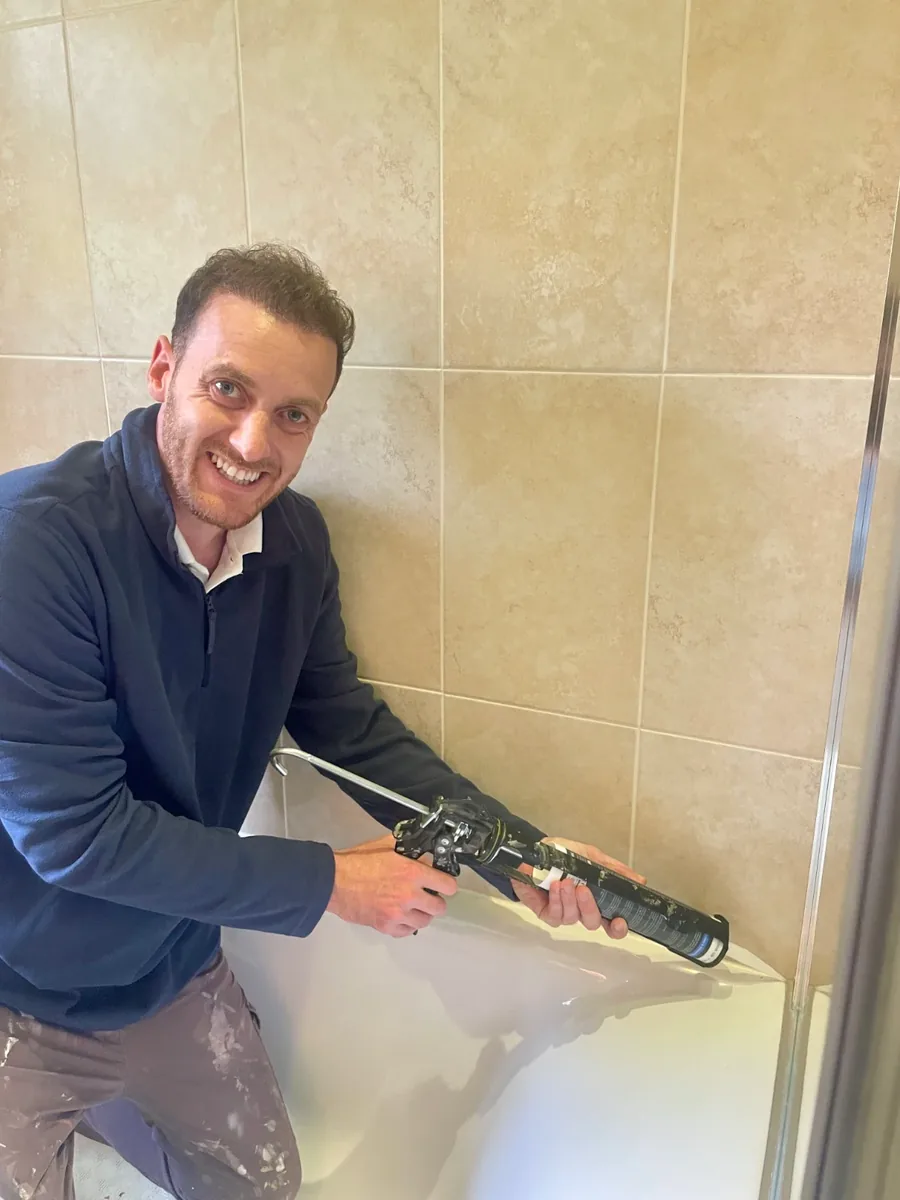
We bring everything the job needs with us. After a quick look at the joints together, the area is protected and the work begins. It normally takes a few hours, depending on how many layers have to come out. In a small place like Oversland, access is usually the main thing to plan. If the job is outside, mention outbuildings, exposed walls and how to reach them.
- First we find out how and where the joint has failed.
- All the old sealant comes out, including any layers underneath.
- Next, any mould is treated and the joint dried.
- Where the joint moves, backing and a flexible sealant suited to the movement go in.
- Finally we finish the joint and talk you through what we found.
Before we arrive
- Try not to wet indoor joints just before the visit
- For business premises, tell us about site rules or sign-in
- Keep children and pets away from the work area
Ask for a quote
For a quote, call 0345 464 0079 or email us and tell us where the job is and what the problem looks like. We’ll give you a clear price before any work starts.
Read more
Nearby places to Oversland
Other services in Oversland
Bathrooms and kitchens in Oversland
Hard water is the norm across most of the South East, which leaves limescale on sealant, grout and fittings, and it has to be cleaned off before new sealant goes in.
In the older streets around Church of St Peter and St Paul, timber floors under older bathrooms flex, so joints need a sealant that moves with them. Managing a site like Boughton-under-Blean and Dunkirk Primary School? Then its toilets, changing areas and kitchens need their sealant renewed like any other building’s.
Oversland is about 4 miles south-east of Faversham, in Kent. Jobs in Oversland get the same care as everywhere else we work: the old material taken out, joints prepared properly and a 12-month guarantee. Our area takes in 922 places across Kent, from the larger towns to small villages. For nearby work, see our Chelmsford page, about 37 miles away.
Here we cover the ME13 postcode area for remedial sealant. We cover properties on Dunkirk Road and South Street and the roads around them. If you’re just outside Oversland, we cover Winterbourne (1 mile north-east), South Street (1 mile west), Hickmans Green (1 mile north), Neames Forstal (1 mile south-west) and Crouch (1 mile north-west). Within a short drive, we also cover Ashford (10 miles south), Canterbury (5 miles east), Sittingbourne (10 miles north-west), Whitstable (6 miles north-east), Faversham (4 miles north-west) and Herne Bay (10 miles north-east).
Around Oversland
Locally, jobs take us to homes and businesses close to Mount Ephraim Gardens and The Sondes Arms. For rail, the closest station is Selling station, roughly 0.6 miles west of the centre. Other landmarks nearby include Eastbridge Hospital of St Thomas the Martyr (5.3 miles east) and Tower keep castle at Chilham (2.6 miles south). The countryside around Oversland includes Blean Woods RSPB Reserve.
When to call us in Oversland
Water from somewhere else can ruin a good seal. A slow leak behind the tiles soaks the joint from the back, and the sealant lifts or goes mouldy from underneath.
Common reasons people contact us include:
- Leaks that keep coming back after resealing
- Smears and lumps from a botched reseal
- Sealant peeling off a dusty or damp surface
- Kitchen joints letting water behind the worktop
For landlords with property near Selling station, failed or mouldy sealant is worth putting right between tenancies, before it turns into a leak.
Before you book anyone
- What guarantee comes with the work
- What insurance they hold
- How hidden problems are handled
- Whether they seal over old material or remove it
Aftercare tips
Good habits help new joints last longer. Our tips:
- Clean sealant with mild products only
- Have loose fittings fixed before resealing
- Act on a lifting corner straight away
- Run the fan after every shower
Don’t let anyone seal over it later. New silicone doesn’t bond to old, so the old bead should always come out first.
A split movement joint lets rain into walls and floors, and left long enough, the edges of the joint can crumble. Resealing while the edges are sound is simpler.
FAQs for Oversland
Is Oversland within the area you cover?
Yes. Oversland is within the area we cover, which takes in towns, villages and rural addresses. Our work covers London and the South East. Just mention lanes, gates or anything else about the route when you book.
Can you help a landlord with a rental near Selling station?
Yes, landlords and agents are among the people we work for, and several properties can be quoted together. You can phone 0345 464 0079 or email us with the details for a clear quote.
How long does remedial resealing take?
Longer than a simple reseal, because every layer has to come out. For most joints, it’s a few hours.
Do I have to be there?
That depends on where the joints are. Inside work needs someone to give us access, while outside work can sometimes be arranged differently.
Do you remove the old sealant?
Yes, every time. New sealant won’t bond properly to old, so any old material comes out before anything new goes in.
Can you strip sealant from an acrylic tray safely?
Yes. Careful removal is most of a remedial job, especially on acrylic, enamel and uPVC.
Are you insured?
Yes. We are fully insured, and we’ve been doing sealant work for more than 20 years.
When is the sealant fully cured?
It depends on the product. Before we leave, we’ll tell you the cure time.
When something else is needed
Before booking, it’s worth knowing the limits too:
- Older mastics that may need an asbestos check before removal
- Plumbing leaks behind walls or under trays
- Tiles that have come away from the wall
If you’re not sure, just ring 0345 464 0079 or email us and we’ll give you a straight answer.
Surfaces we seal
- Leaking tray & enclosure joints
- Failed movement joints
- Shrunken worktop sealant
- Botched or over-sealed joints
- Mouldy bath & shower sealant
- Expansion joints
What the job involves on each surface
Worktops & kitchens
Shrunken worktop sealant leaves a gap that lets water into the back edge. We strip it, degrease the joint and reseal colour-matched to the worktop.
Over-sealed & botched joints
Every layer has to come out, including the smears and film on surrounding tiles. Only a clean joint will take a new bead.
DIY sealant or a professional job?
If you do try it yourself, take your time over the preparation: take out all the old sealant, make sure the joint is clean and dry, and give it the full cure time. If it fails, we can still redo it.
Sealing over old silicone is the commonest DIY error. New silicone won’t bond to old, so it lifts and traps water and mould underneath. Everything old must be removed first.