
Hampshire · England
Hollywater External Mastic
We cover Hollywater for sealing brickwork movement joints, render, cladding and façade joints. Old sealant removed completely, joints prepared properly and every job guaranteed for a year.
- Old sealant gone brittle and cracked
- Rain getting behind render or cladding at a joint
- Failed sealant between panels on a façade
How we handle external mastic in Hollywater
A movement joint is a deliberate break that lets a wall expand and contract. The sealant in it has to stretch and squeeze for years, so once it splits or hardens, the joint stops working and water gets in. If you have hard, crazed mastic that has stopped moving and movement joints filled with mortar instead of sealant, we can help, on joints between brick and frames, concrete & block and render & cladding joints alike.
Outside joints can only be sealed when they’re dry, so work in Hollywater is booked around the forecast. Tell us about access to all sides of the building, including outbuildings and garages.
There’s a 12-month guarantee on every job, large or small.
- Where
- Hollywater (GU35)
- Region
- Hampshire
- Cover
- A year, on every job
- Price
- A clear quote up front
- Telephone
- 0345 464 0079
- Updated
- 26 October 2026
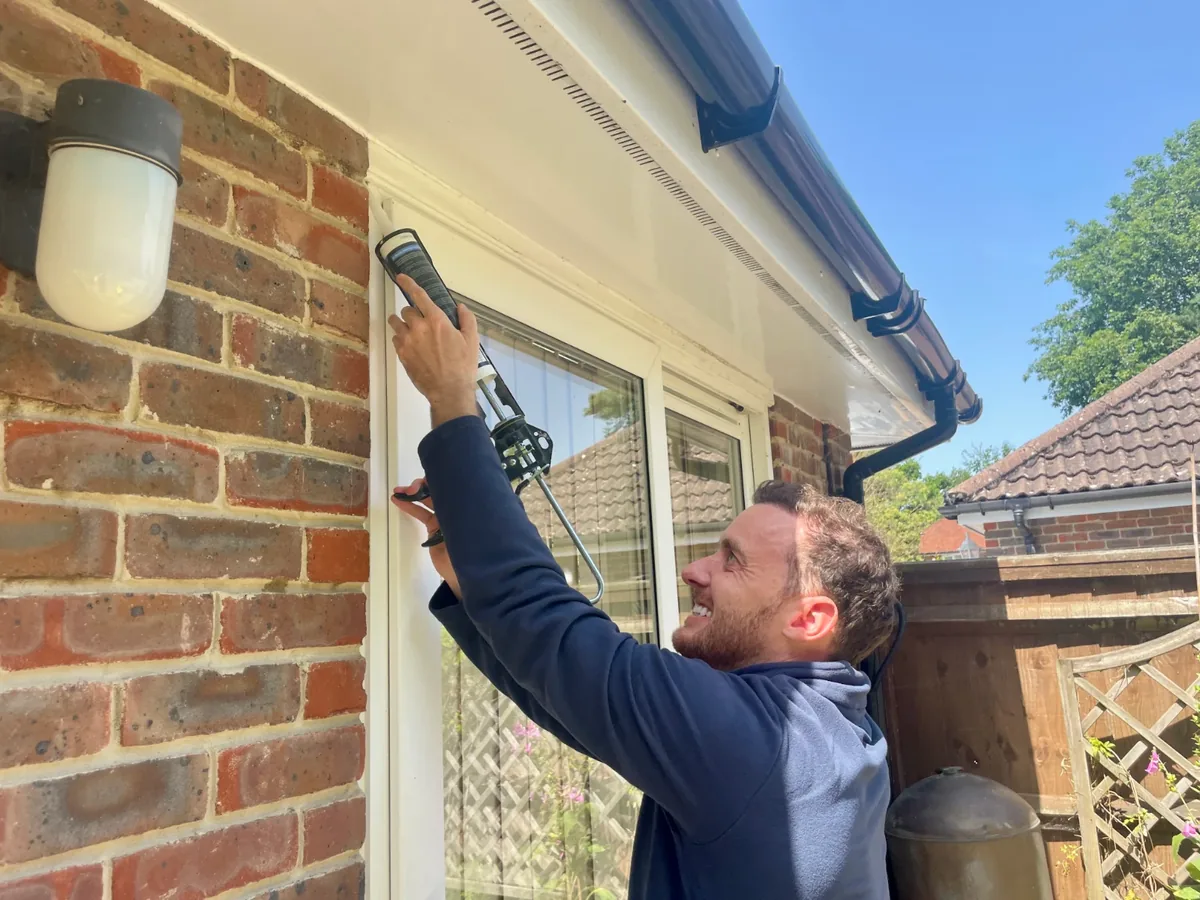
What the job involves on each surface
Copings and trims
Copings expand and contract through the day, so a flexible sealant suits them best year round.
Joints between dissimilar materials
Brick against render, concrete against metal, stone against timber: every change of material is a joint. A flexible sealant bridges the two.
Also in Hollywater
Do you need external mastic in Hollywater?
Joints sealed without backing rod, or far too deep, rarely last. If the sealant sticks to the back as well as the sides, it can’t stretch and rips as the joint opens.
These are the problems we are asked about most:
- Sealant pulling away from one side of the joint
- Weeds or debris growing in open joints
- Brick movement joints where the sealant has split
- Water getting into walls through failed joints
If you let a flat or house near Liphook station, split movement joints are easy to miss on a rental until damp shows inside.
What your quote should include
- What preparation is included
- What insurance they hold
- What the quote includes, VAT included or not
- Whether you can choose the colour
For landlords and businesses
In hotels, rooms out of use cost money, so we plan the work room by room around your bookings where we can. Hotel work is part of what we do, alongside homes and businesses.
We work for landlords and letting agents as well as homeowners. Resealing between tenancies keeps a property looking cared for before the next move-in.
How it works
When we arrive, we start by going over the job with you, so there are no surprises. We protect the surfaces around the joints before work begins. Most jobs take anything from a few hours to several days, depending on the building. Somewhere as small as Hollywater, access is often the only tricky part. For outside work, also let us know about exposed walls and any outbuildings involved.
- Each joint is checked and the colour of the new sealant agreed.
- Failed sealant is removed back to clean, sound faces.
- Closed-cell backing rod is pushed in so the sealant bonds to two sides only.
- Primer is applied wherever the sealant needs it.
- A low-modulus exterior sealant is gunned in and tooled to a neat finish.
Getting ready for the visit
- Tell us if parking is tricky
- Mention any leaks or damp you’ve noticed
- Let us know about stairs, lifts or work at height
Get a quote
Call for a quick quote, or send an email if you’d rather. Tell us about the joints that need doing and we’ll talk you through the work and give you a clear price.
Advice
Outside joints around Hollywater
Compared with the north and west, the South East gets less rain, but outside sealant still needs a dry, clean surface, so outdoor work is planned around the forecast.
If you live in an older home near St Mark's Sacred Church, the joints between older walls, newer extensions and the roofline need a sealant that can move. For site and facilities teams at buildings such as Woodlea Primary School, larger buildings have long runs of movement joint that eventually need resealing.
Hollywater is about 6 miles south-east of Alton, in Hampshire. If you need external mastic in Hollywater, it’s easy to get a quote: please phone 0345 464 0079 or send us an email. We cover Hampshire from our Crawley base. 683 places in Hampshire are on our list. You can also see our page for Portsmouth, about 23 miles away.
Work in GU35 is quoted and booked the same way as anywhere else. Whether your property is on Hollywater Road and Liphook Road or anywhere close by, our applicators can take on the job. Nearby, we also carry out external mastic in Standford (1 mile north-east), Whitehill (1 mile west), Deadwater (1 mile north), Bordon (1 mile north-west) and Lindford (1 mile north). Further out, we also cover Farnborough (14 miles north), Fleet (12 miles north), Horndean (15 miles south-west), Aldershot (11 miles north), Alton (6 miles north-west) and Petersfield (8 miles south-west).
Around Hollywater
Around Hollywater, our work takes us to homes and buildings near Mill Chase Academy, among other places. The closest station to Hollywater is Liphook station, about 3.1 miles south-east. A little further out are The Romany Museum (3.9 miles west) and Chase Community Hospital (0.6 miles north-west). Open spaces near Hollywater include Wheeler's Down and Deadwater Valley.
What happens if it’s left?
It often makes sense to reseal all the failing joints on an elevation together. Joints of the same age tend to fail together, and access only has to be arranged once. In a small place like Hollywater, homes can be exposed to wind and rain, which finds any gap, and older walls, once damp, take a long time to dry.
There are no prices on our website, because the cost depends so much on the job itself. Call for a quick quote.
What you get with us
- Sealant colour chosen to suit
- A choice of colours where the product allows
- We agree the colour with you first
- Full insurance on every job
Read our cost guide or our reviews.
What we cannot put right
Sealant is not the answer to every problem, and we will tell you before any work starts. It will not solve:
- Render that’s blown, hollow or coming away
- Subsidence or other structural problems
- Cutting new joints into brickwork, which is building work rather than sealant work
If you’re not sure, just ring 0345 464 0079 or send us an email and we’ll give you a straight answer.
Where we work in Hollywater
- Render & cladding joints
- Façade panels
- Joints between brick and frames
- Copings & trims
- Brickwork movement joints
- Concrete & block
Your questions about external mastic in Hollywater
Will you come out to Hollywater?
Yes, we do. Our work covers London and the South East, and smaller places are part of that. The journey is planned ahead, so it helps to know about access.
Can you do external mastic in Hollywater?
Yes. We work across London and the South East, and Hollywater is part of that. You can call 0345 464 0079 or send us an email and let us know what needs doing, and we’ll give you a clear price.
What should I tell you?
The location, the problem and the rough size of the job. If you can, email a few pictures.
Are you insured?
Yes. Full insurance covers our work.
Is it OK to seal over old sealant?
No. Fresh sealant does not stick to old sealant, and it traps any mould or water underneath. We remove it all first.
Can you seal joints between two different materials?
Yes. Joints between dissimilar materials are a big part of external work. The sealant is chosen to bond to both sides with primer where required.
I rent my home. Can I book you?
Of course. Ask your landlord first, and we can send them the quote if that helps.
What is backing rod for?
We fit closed-cell backing rod wherever the joint depth needs controlling. It sets the sealant depth and prevents three-sided bonding, so the joint can move.
How to look after the new joints
Joint life depends on how it’s used and looked after. Here’s what we suggest:
- Look over the joints every year, ideally after winter
- Clear growth from the base of walls and joints
- Show decorators and builders where the movement joints are
- Never let anyone fill a movement joint with mortar
Have a quick look at the joints each spring. Watch for splits, edges coming away or growth in the joint.
An open movement joint lets rain into the wall every time it pours. That can lead to damp patches, staining and frost damage which cost more to put right than the joint.