
West Dunbartonshire · Scotland
External Mastic in Clydebank
Sealing brickwork movement joints, render, cladding and façade joints for Clydebank, backed by a one-year guarantee. Ask us for a quote.
- Damp patches traced to an open external joint
- Movement joints with cracked, split or missing sealant
- Gaps where render, brick and frames meet
What we can’t put right
Honest advice matters more to us than a booking, so here’s what sealant can’t fix:
- Walls that need new movement joints cut into them
- Cracking across the wall rather than at a joint
- Loose or hollow render, which needs re-rendering
Not sure which it is? You can email us at info@mrmastic.co.uk and we’ll tell you honestly before you book.
What we seal
- Brickwork movement joints
- Concrete & block
- Façade panels
- Copings & trims
- Render & cladding joints
- Joints between brick and frames
External mastic for homes and businesses in Clydebank
Short cuts in external joints show up within a season or two. New sealant over old, joints packed with mortar and beads with no backing all tend to fail early. We take the old material out and do it properly. We work on copings & trims, joints between brick and frames and concrete & block, and the jobs we see most are brick movement joints where the sealant has split and rigid filler in a joint that should flex.
Harled walls are common in Scottish towns like Clydebank, and sealing where harling meets a frame or pipe takes a sealant that can grip a rough surface. Rooflines take their share of the weather as well.
All of our work is guaranteed for twelve months, in Clydebank and everywhere else we cover.
- Where
- Clydebank (G81, G60, G14)
- Wider area
- West Dunbartonshire
- Guarantee
- One year on every job
- Quotes
- A clear price before we start
- info@mrmastic.co.uk
- Last updated
- 26 October 2026
Other services in Clydebank
Why it’s worth doing now in Clydebank
Resealing a run of joints in one go is generally better than patching one at a time. Joints of the same age tend to fail together and it means sorting access once. If you live in a flat in Clydebank, failed sealant can send water to the neighbours below, which turns a small job into a bigger one.
What it costs depends on the size of the job, how much old material has to come out and access to the work. You will have a clear quote before any work starts.
Why Clydebank clients choose us
- A sealant colour to suit the surroundings
- ARBOMaster approved applicator
- Neat joints and a tidy finish
- White, clear, grey or coloured to suit, where the product allows
See our cost guide and customer reviews.
External mastic in Clydebank: local notes
Clydebank is within about 3 miles of the coast, where wind-driven rain is a fact of life and, nearer the shore, so is salt air. That’s hard on movement joints and outside wall joints, especially on the side facing the sea. Clydebank is in the west of Scotland, which is wetter than the east, which means movement joints and outside wall joints has to cope with a lot of rain.
For site and facilities teams at buildings such as Clydebank High School, larger buildings have long runs of movement joint that eventually need resealing.
Clydebank is about 7 miles north-west of Glasgow, in West Dunbartonshire. We provide external mastic to homes and businesses in Clydebank and nearby. Across West Dunbartonshire, we cover 31 places, and Clydebank is one of them. We also work in Glasgow, around 7 miles away.
Postcode districts we cover here for external mastic: G81, G60 and G14. If you need external mastic at a property on Carinthia Square, Station Road and Broom Drive or a nearby road, we can help. You’ll find Clydebank on the A82 and A810, which makes it straightforward to reach with everything needed for external mastic. Close by, we work in Hardgate (1 mile north-east), Drumry (1 mile south-east), Dalmuir (1 mile south-west), Faifley (1 mile north-east) and Duntocher (1 mile north). We also work in nearby towns such as Dumbarton (6 miles west), Alexandria (8 miles north-west), Crosslet (6 miles west), Balloch (9 miles north-west), Dalreoch (7 miles west) and Kirktonhill (7 miles west). Being one of West Dunbartonshire’s larger places, Clydebank has every kind of property, from flats to offices.
What’s near Clydebank
Clydebank’s nearest station is Singer station, about 0.6 miles south of the centre. A little further out are Renfrew Museum (2.7 miles south) and Golden Jubilee National Hospital (0.8 miles south-west). For a walk, there’s Dalnottar hill and Cochno Loch.
Work for landlords, hotels and businesses
Hotels need rooms back in use, so the work can be planned room by room around your bookings where we can. Hotel work is part of what we do, alongside homes and businesses.
From a single let to a portfolio, the work is the same standard: old sealant fully removed, joints prepared properly and a 12-month guarantee.
Your questions about external mastic in Clydebank
Is Clydebank in your area for external mastic?
Yes. We work across all of Scotland, and Clydebank is part of that. Just email us at info@mrmastic.co.uk with a few details of the job, and we’ll send you a clear quote.
Is external mastic in a coastal place like Clydebank any different?
Coastal weather is harder on outside sealant: there’s more wind-driven rain and, closer to the shore, salt in the air. The right product, a clean joint and the right depth all help it cope.
I rent my home. Can I book you?
Yes, though it’s best to check with your landlord first. Many landlords are glad to have it sorted.
Is it OK to fill a movement joint with cement?
No. Rigid materials can’t move with the wall, so the joint stops doing its job. If it has already been filled, we can usually cut it out and reseal it.
What does external mastic cost?
It depends on the job, so we quote each one individually. For a quick quote, email us at info@mrmastic.co.uk with a short description of the job.
Are you ARBOMaster approved?
Yes. We are an ARBOMaster approved applicator, the approved applicator scheme for Arbo sealants.
Can you work on commercial sites?
Yes. Larger jobs can be planned room by room or area by area.
Do you have insurance?
Yes. Mr Mastic is fully insured, and we’ve been doing sealant work for more than 20 years.
How we quote for external mastic
The quote reflects the job in front of us. We look at:
- The product the joint needs
- When we can work, for business premises
- How many rooms, windows or areas are involved
- The old material and how stubborn it is
Instead of a standard rate, we look at what your job involves: how many joints, what’s in them now and how we reach them. You will know the price before we begin.
What we need to know
The more you tell us, the more accurate the quote. When you get in contact, it helps to mention:
- How many joints, rooms or windows are involved
- Any access issues, like height or stairs
- Where the job is, and your postcode
- Pictures of the joints, sent by email
The more we know about the job, the more useful the quote. Tell us where the job is, what’s wrong and how much there is.
The process
There’s no need to move everything out before we come, only the area right around the joints. We protect the rest, and the job takes anything from a few hours to several days, depending on the building for a typical job. A visit in Clydebank needs three things planned: access, parking and where the work is. Outdoor jobs need a dry day, so they can move if the weather turns.
- First, the joints are inspected and the access agreed.
- Every bit of old sealant and any mortar or debris is cut out.
- The faces are brushed clean and primed where the product requires it.
- We fit closed-cell backing rod to control the depth.
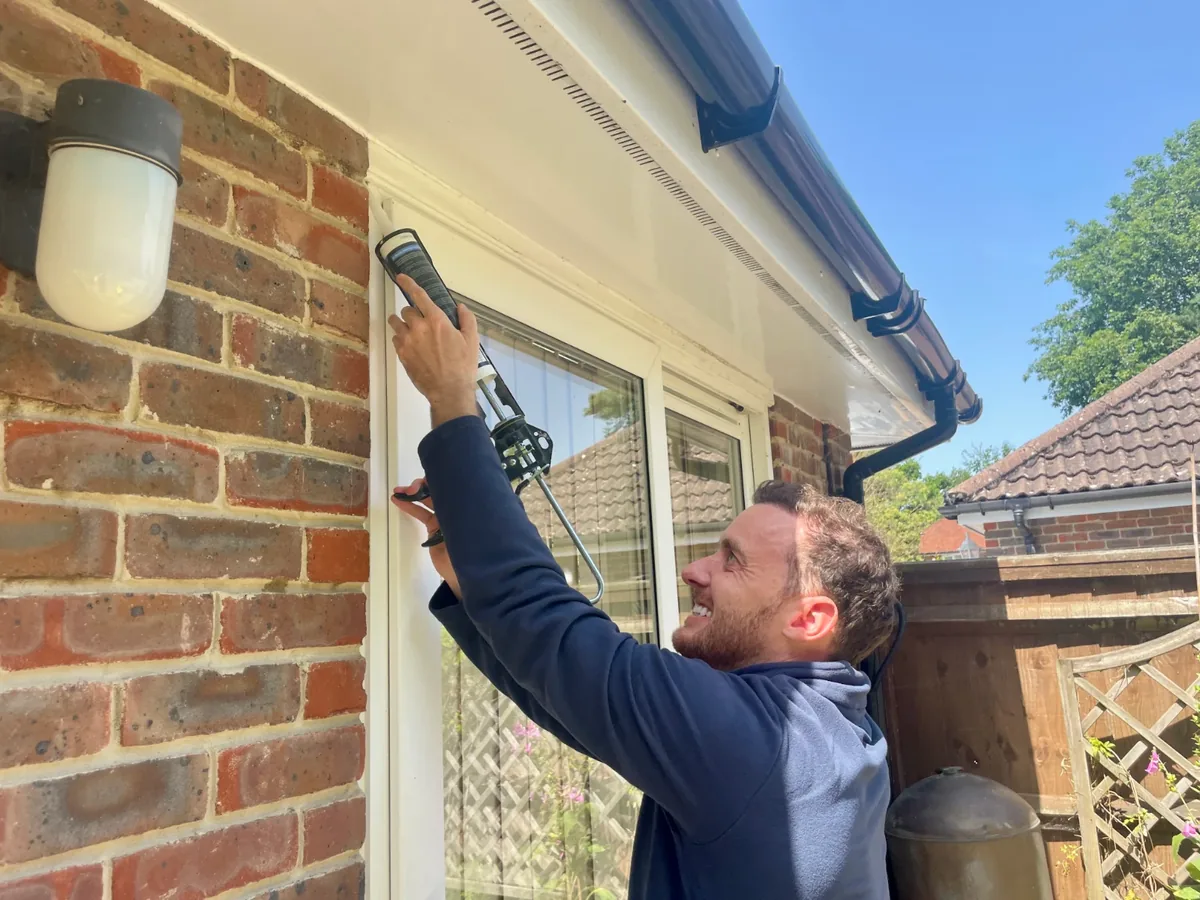
- We apply the sealant, tool it and check the whole run.
Preparing for the visit
- Plan for the work area to be out of bounds to pets and children
- Tell us about access, such as stairs, a lift or high-level joints
- Mention any leaks or damp you’ve noticed
Get a quote
For a quick quote, get us on the phone, or email us if that’s easier. Describe what needs sealing and we will talk you through the work.
Related advice
Common problems we fix in Clydebank
Every building moves. Brickwork grows a little over the years, blockwork and concrete shrink, and all of it moves with heat and moisture. The sealant in the movement joints takes that strain.
The most common problems we see are:
- Plants rooting in failed movement joints
- Brick movement joints where the sealant has split
- Leaking joints around cladding and façade panels
- Damp patches traced to an open external joint
Rented homes near Singer station change hands often, and outside joints that have cracked can let damp into a rental, so check them between lets.
Questions to ask before you book
- How the surfaces are prepared before sealing
- Is the old sealant removed completely?
- What product goes in the joint
- Whether they’re fully insured
Different surfaces, different methods
Brickwork movement joints
Brick moves with heat and moisture, and grows a little over time. That movement goes into the joint, so the sealant in it must stay soft and stretchy.
Copings and trims
A failed coping joint lets water into the top of the wall. Sealing them early saves the wall below.