
Surrey · England
The Chart Bathroom Resealing
Our applicators work in The Chart on bath, shower, basin, wet room, worktop and sink resealing. Old sealant removed completely, joints prepared properly and a 12-month guarantee.
- Black spots spreading through the bead
- Lumpy, uneven sealant from a DIY attempt
- A bead that has pulled away from the tiles
Bathroom resealing in The Chart
Across The Chart, the joints we reseal are the ones that fail in any home: bath edges, tray joints, basin backs and kitchen upstands. Each one is stripped, cleaned and dried before new silicone goes in. If you are dealing with a reseal done over the top of the old bead and a bead that has pulled away from the tiles, we can put it right, on shower trays & enclosures, basins & vanity units and wet rooms alike.
In a village or hamlet like The Chart, homes are often older cottages and farmhouses alongside a few newer houses. Movement in older walls and floors tends to show first as cracked grout or split sealant.
We guarantee the work for a year. If something is not right with it in that time, tell us and we’ll put it right.
- Location
- The Chart (RH8)
- Wider area
- Surrey
- Cover
- One year on every job
- Quote
- Quoted before any work starts
- Phone
- 0345 464 0079
- Page updated
- 26 October 2026
When something else is needed
In fairness, there are a few things sealant will not fix:
- A cracked shower tray or bath (that needs repair or replacement)
- Cracked or missing grout between tiles (that’s regrouting)
- Tiles that have come away from the wall
Not sure which it is? You can phone 0345 464 0079 or send us an email and we’ll tell you honestly before you book.
Joints and surfaces we work on
- Sinks & splashbacks
- Baths
- Basins & vanity units
- Kitchen worktops & upstands
- Shower trays & enclosures
- Wet rooms
Your questions about bathroom resealing in The Chart
Is The Chart in your area for bathroom resealing?
Yes, The Chart is within the area we cover. We work across London and the South East. You can call 0345 464 0079 or send us an email and let us know what needs doing.
Will you come out to The Chart?
Yes, we do. Our work covers London and the South East, from towns to the smallest places. Longer journeys are simply planned in advance.
Is it messy?
We keep the work tidy. Nearby surfaces are protected, and the area is left clean when we finish.
How long does a bath or shower reseal take?
A single bath or shower takes about a couple of hours, old sealant removal included. A whole bathroom plus the kitchen may take most of the day.
Do you have insurance?
Yes. Full insurance covers our work.
Where is Mr Mastic based?
We are based in Crawley, and we work across South East England, London and Scotland.
What do you put in the joint?
It depends on the joint: sanitary silicone where it gets wet, and sealants suited to movement or weather elsewhere. Brands we use include Arbo and Everbuild.
Does the resealing come with a guarantee?
Yes. Our 12-month guarantee covers every job, and we’re ARBOMaster approved applicators.
Leave it or put it right?
A clean new bead makes a room look cared for, which helps when a home is being let or put on the market. A smeared, uneven DIY bead does the opposite. Older cottages and farmhouses around The Chart can have timber floors and frames, where water from a failed joint can cause rot if it’s left.
No two jobs are quite the same, so each one gets its own quote. Size, access and the product the joint needs all play a part, and we’ll explain the quote if you ask.
Why The Chart customers choose us
- White, clear, grey or coloured to suit, where the product allows
- Colour picked to suit the job
- Quality sealants from Arbo and Everbuild
- Domestic, commercial and hotel work
Read what affects the cost and what customers say.
Signs you need bathroom resealing in The Chart
Baths and trays move. An acrylic bath flexes under load, and a tray that isn’t fully bedded can rock. Over time the joint tears or pulls away from the tile.
Common reasons people contact us are:
- A reseal done over the top of the old bead
- Lumpy, uneven sealant from a DIY attempt
- Black spots spreading through the bead
- Cracked, shrunken or lifting silicone
If you let a flat or house near Hurst Green station, a reseal between tenants is a quick way to make the bathroom and kitchen look cared for.
What your quote should include
- What happens if they find a problem under the old sealant
- Whether they seal over old material or remove it
- How long to leave it before use
- What guarantee comes with the work
Bathroom resealing around The Chart
Hard water is the norm across most of the South East, which leaves limescale on sealant, grout and fittings.
Homes close to St Andrew's include some older properties, and older homes can move a little, which is hard on rigid grout and tired sealant. If you look after a building such as Limpsfield CofE Infant School, its toilets, changing areas and kitchens need their sealant renewed like any other building’s.
The Chart is about 6 miles south-east of Caterham, in Surrey. From the centre of The Chart to the outskirts, bathroom resealing is available for homes and businesses alike. Across Surrey, we cover 395 places, The Chart among them. You can also see our page for Crawley, about 14 miles away.
Jobs for bathroom resealing in RH8 works the same way as everywhere else we cover. You will find streets such as Stoneleigh Road, St Andrews Way and Ridlands Lane. Other places close to The Chart include Pains-Hill (1 mile west), Moorhouse Bank (1 mile north-east), Goodley Stock (1 mile east), Limpsfield (1 mile north-west) and Crockham Hill (1 mile south-east). Within a short drive, we also cover Epsom (15 miles north-west), Horley (10 miles south-west), Redhill (9 miles west), Ewell (15 miles north-west), Reigate (10 miles west) and Caterham (6 miles north-west).
Landmarks near The Chart
Around The Chart, our work takes us to homes and buildings near Carpenters Arms, Oxted School and Hazelwood School, among other places. The Chart’s nearest station is Hurst Green station, roughly 1.6 miles west of the centre. A little further out are Tandridge Priory (0.6 miles north-west). Not far away are Botley Hill and Bay Pond.
How the visit works
When we arrive, we look over the joints with you first, so you know exactly what we’re doing. We protect the surfaces around the joints before any work begins. Most jobs take a morning or an afternoon for most single baths and showers. In a small place like The Chart, access is normally the main thing to plan. If the job is outside, mention outbuildings, exposed walls and how to reach them.
- We look at every joint first and check for movement or leaks.
- The old silicone is cut out completely, along with the film it leaves on the tiles.
- The joint is cleaned, degreased and treated for mould.
- With the joint dry, and any bath loaded with water, a single bead of anti-fungal silicone is applied.
- The bead is tooled smooth and you are told the cure time, generally around 24 hours.
Before we arrive
- Move anything stored near the joints
- Keep children and pets away from the work area
- Tell us about any water getting in
Getting a quote
It all starts with a short chat. Describe the problem, the location and the size of the job. Whenever you’re ready, call 0345 464 0079 or send us an email.
Advice
Keeping the joints in good condition
Once the sealant has cured, a few habits help it last:
- Give the silicone its full cure time
- Keep the fan on for a while after bathing
- Use gentle cleaners on the silicone
- Check the joints every few months for splits or lifting
Treat the new bead gently when you clean: a mild bathroom cleaner and a soft cloth is enough. Scourers and blades can nick the surface, and a nicked bead lets mould in sooner.
Mould that starts as a few spots spreads through the bead. When it has grown right through, it rarely cleans out, and nearby grout often goes the same way. Replacing the sealant early keeps the job small.
DIY versus a professional finish
What a professional job adds is preparation and the right product. We take joints back to clean, dry surfaces, and the sealant is chosen for how the joint moves and where it is.
Not every job suits DIY: high-level joints, fire-rated gaps, external movement joints and big jobs need the right product, the right access and the right method.
Places near The Chart
What else we do in The Chart
Different surfaces, different methods
Baths
A bath shifts slightly every time it’s filled, so we fill it with water before sealing. The joint is then laid with the bath at its lowest point and is not torn the first time it’s used.
Shower trays & enclosures
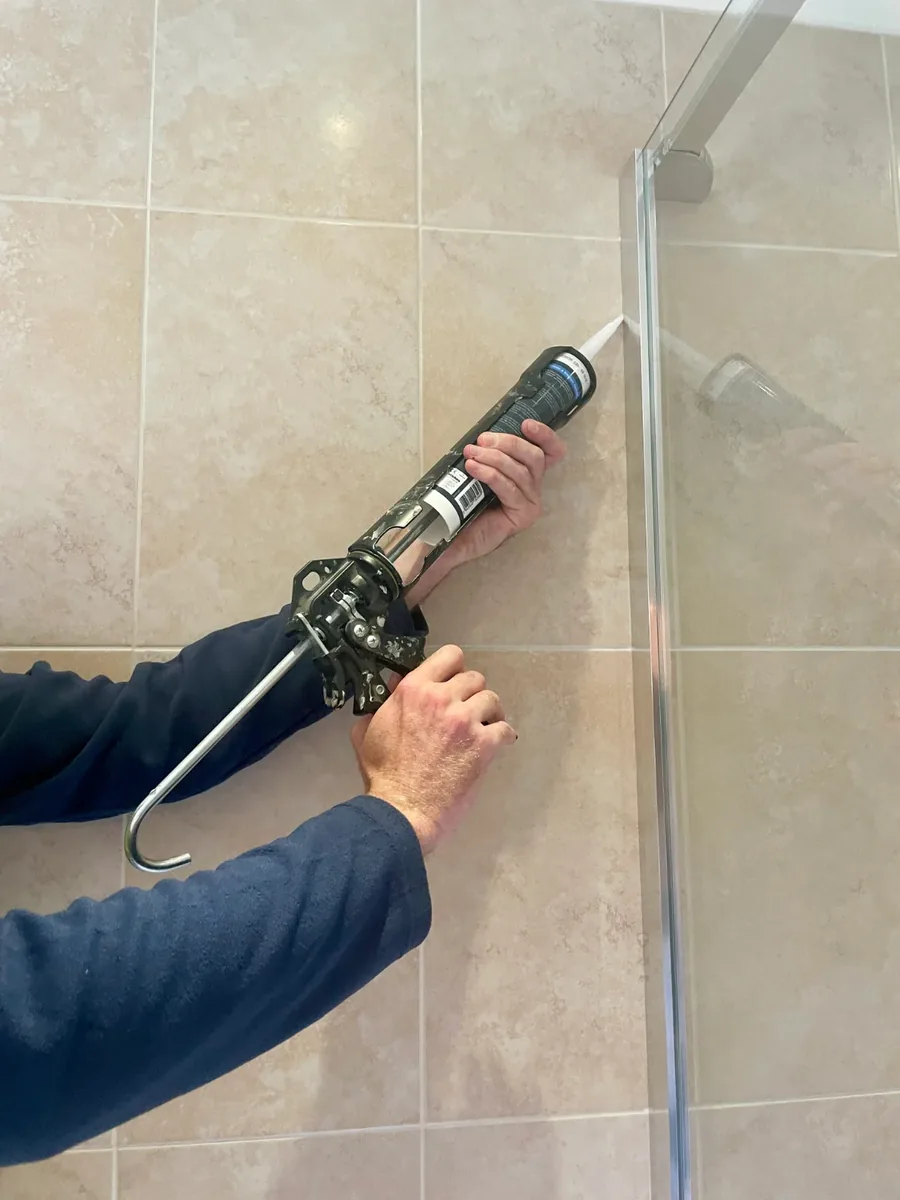
The vertical joint where a screen profile meets the wall is a common leak point. It’s resealed along with the tray joints, sealing the side the enclosure’s instructions call for.