
Glasgow · Scotland
Stepps Bathroom Resealing
Bath, shower, basin, wet room, worktop and sink resealing for homeowners, landlords and businesses in Stepps. Fully insured, ARBOMaster approved and guaranteed for a year.
- Gaps between the worktop and the wall
- Smears of silicone across the tiles
- Water escaping at the shower enclosure
Bathroom resealing in Stepps
The secret of a lasting bead is the preparation. The old sealant is removed to the last smear, after which the joint is degreased and any mould treated. Only once it’s dry does the new bead go on. Common call-outs are for smears of silicone across the tiles and black spots spreading through the bead, on basins & vanity units, baths and kitchen worktops & upstands.
A bathroom in a place like Stepps gets the same daily wear as one in a city flat. Generally soft Scottish water means less limescale, but steam still lets mould into sealant and grout.
A one-year guarantee comes as standard, so you’re not left on your own once the job is done.
- Place
- Stepps (G33)
- Region
- Glasgow
- Guarantee
- One year on every job
- Price
- Quoted before any work starts
- info@mrmastic.co.uk
- Last updated
- 26 October 2026
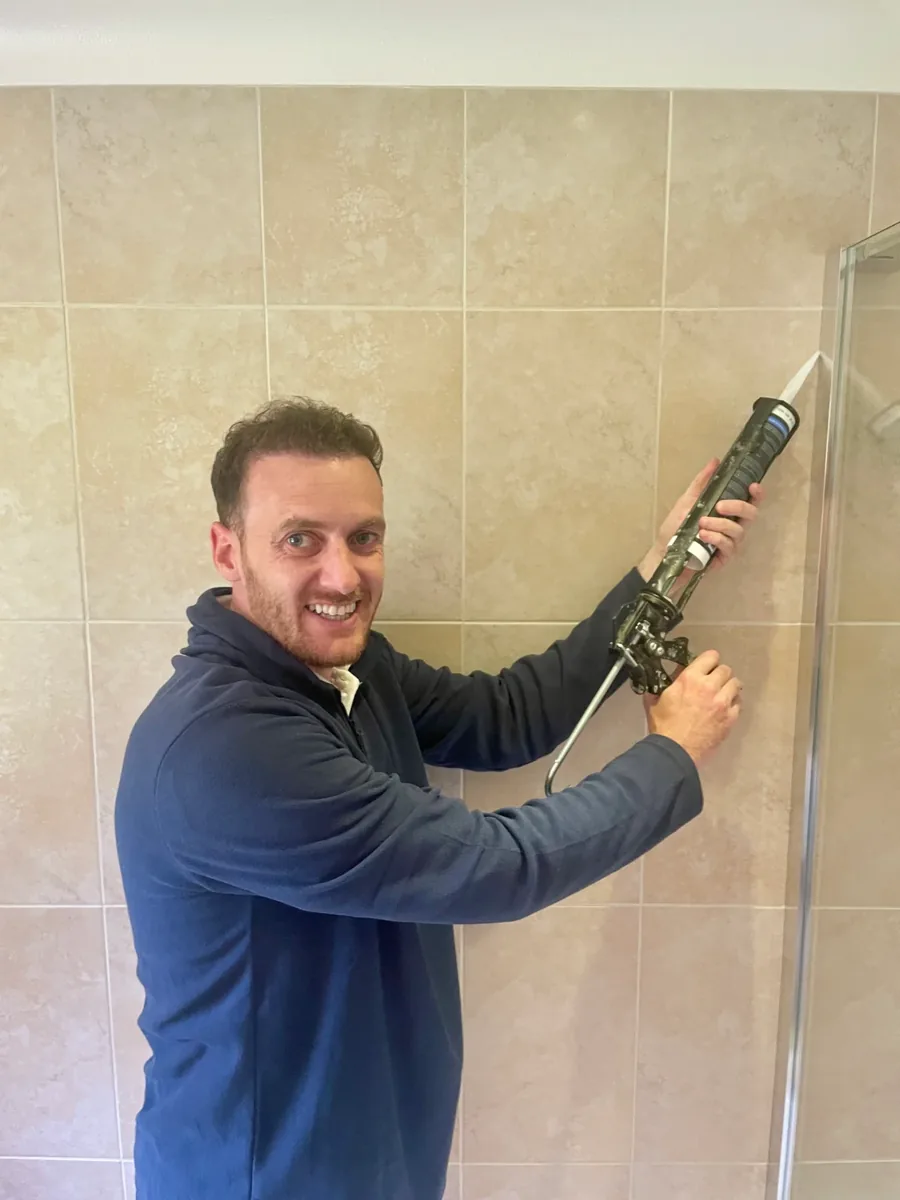
Bathroom resealing around Stepps
Sandstone tenements are a big part of Glasgow’s housing, so many bathrooms sit right above a neighbour’s ceiling. In Scotland, private landlords have to meet the Repairing Standard, which covers keeping fixtures and fittings in a reasonable state of repair. Failed sealant around a bath or shower is worth sorting between tenancies.
Letting a property close to Stepps station? Then a reseal between tenants is a quick way to make the bathroom and kitchen look cared for.
Stepps is about 3 miles south of Kirkintilloch, in Glasgow. Our applicators cover bathroom resealing for householders, landlords and businesses in Stepps and the surrounding area. 183 places in Glasgow are on our list, large and small. There’s also a page for Glasgow, about 6 miles away.
Every address in G33 is within our area for bathroom resealing, from the main roads to the quietest streets. Whether your property is on Station Road, Mcbride Path and Garnkirk Lane or a nearby road, we can help. Stepps sits on or near the A80, which makes travel easy. Other places close to Stepps include Garnkirk (1 mile east), Millerston (1 mile west), Garthamlock (1 mile south), Provanhall (1 mile south) and Craigend (1 mile south-west). Further out, we also cover Glasgow (6 miles south-west), Hillhead (6 miles west), Dowanhill (6 miles west), Woodlands (6 miles west), Woodside (5 miles west) and North Kelvinside (5 miles west).
Near you in Stepps
There’s a railway station in Stepps itself: Stepps station. Other landmarks nearby include Bedlay Castle (2 miles north-east) and Glasgow Fort (1.3 miles south). For a walk, there’s Lenzie Moss and Hogganfield Loch.
More services for Stepps
Why deal with it now?
You don’t need a new bathroom because the sealant looks bad. A new bead often brings the whole room back. If something else is wrong, we’ll tell you. Out of town in Scotland, exposed walls take a lot of weather, and once water gets behind a failed joint, damp in stone or harled walls is slow to dry out.
Combining jobs into one visit is usually more efficient than separate visits. You will get one clear quote for the whole job.
Why choose Mr Mastic in Stepps
- 20+ years of sealant experience
- We agree the colour with you first
- We never seal over old sealant
- Neat joints and a tidy finish
Read what affects the cost and what customers say.
Common problems we fix in Stepps
With age, silicone loses its stretch. Along worktops it tends to pull back from the wall, leaving a thin gap where water and food collect. Hot pans and harsh cleaners don’t help.
Common reasons people contact us are:
- Gaps between the worktop and the wall
- A bead that has pulled away from the tiles
- Mouldy sealant that has gone black
- Two layers of silicone, both failing
For site and facilities teams at buildings such as Chryston High School, its toilets, changing areas and kitchens need their sealant renewed like any other building’s.
What to look for in a quote
- How the joint is cleaned and prepared
- How long to leave it before use
- What happens if the job turns out different
- What the quote includes, VAT included or not
Different surfaces, different methods
Wet rooms
If a wet room leaks, the cause may be the tanking or the drain rather than the joints. We reseal the joints and will tell you if the water seems to be coming from somewhere else.
Kitchen worktops & upstands
Upstands and back edges are cut out, cleaned of grease and resealed, because cooking grease stops sealant bonding. The extra cleaning is what makes the bead last.
DIY sealant or a professional job?
If you do try it yourself, take your time over the preparation: remove every trace of old sealant, clean and dry the joint, and follow the product’s cure time. If it fails, we can still redo it.
Sealing over old silicone is the commonest DIY error. Silicone does not stick to old silicone, so it lifts and traps water and mould underneath. Everything old must be removed first.
FAQs for Stepps
Do you cover Stepps for bathroom resealing?
Yes. Our work covers the whole of Scotland, and Stepps is part of that. Just email us at info@mrmastic.co.uk with a few details of the job, and we’ll send you a clear quote.
Will you come out to Stepps?
Yes. Stepps is within the area we cover, which takes in towns, villages and rural addresses. Our work covers the whole of Scotland. Just mention lanes, gates or anything else about the route when you book.
Is white the only colour available?
Most people choose white or clear, but other colours can be used to suit tiles and worktops. Let us know your preference when you ask for a quote.
Can you just seal over the old silicone?
No, never. A bead laid over old silicone soon starts to come away. Every trace of the old bead is removed first.
Can you work on commercial sites?
Yes. Hotels, offices and other businesses use us.
Are you ARBOMaster approved?
Yes. ARBOMaster is the approved applicator scheme for Arbo sealants, and we are part of it.
How long does it take to reseal a bath or shower?
It depends on how many joints there are and how much old sealant has to come out. For most single baths or showers, allow a couple of hours.
Do I have to be there?
We need access to the joints, so we’ll agree that with you when we book. For inside work, that normally means someone being in.
Keeping the joints in good condition
Once the sealant has cured, a few habits help it last:
- Stick to a soft cloth and a mild cleaner
- Keep bottles off the sealant line
- Dry the bead with a towel now and then
- Keep the fan on for a while after bathing
Do not stand bottles along the bead, because they trap water against the silicone. A quick squeegee after showering helps the joint dry.
Small signs come before a leak: a corner lifting, a gap behind the bead, a dark line under the silicone or a damp patch on the ceiling below. Any of these means the joint needs attention.
When it isn’t the sealant
It helps to know what we cannot do too:
- Water getting in through the grout rather than the sealant
- Water coming from the plumbing rather than the joint
- Tiles that have come away from the wall
If in doubt, send an email to info@mrmastic.co.uk and we’ll say what we think.
What we seal
- Sinks & splashbacks
- Kitchen worktops & upstands
- Basins & vanity units
- Wet rooms
- Baths
- Shower trays & enclosures
How it works
There’s no need to move everything out, only the area right around the joints. We protect the rest, and the work takes a couple of hours for a single bath or shower for a typical job. In smaller Scottish places, parking is normally less of an issue than access and distance. Let us know how to find you and how to reach the joints, and the visit is planned around that.
- We protect the area and cut out all of the old sealant, including the film left on the tiles.
- The joint is cleaned, degreased and treated for mould.
- Once it’s dry, any bath is filled so the bead is laid with it at its heaviest.
- New anti-fungal silicone goes on in a colour to suit and is tooled to a clean finish.
- Finally we tidy up and explain the cure time before we leave.
Preparing for the visit
- Let us know if you’ve seen damp or leaks
- Move anything stored near the joints
- Tell us about any previous sealing or DIY attempts
Getting a quote
Getting a quote is simple: let us know the job and the location, and roughly how big it is. Photos by email help us understand the job, and we will take it from there.