
Hampshire · England
Bathroom Resealing in St Ives
Bathroom resealing for St Ives, by sealant specialists with 20+ years’ experience. 180+ five-star Google reviews and a 4.9 rating.
- Gaps where the bath or tray has moved
- A bead that has pulled away from the tiles
- A messy, uneven bead from a previous reseal
Keeping the joints in good condition
Aftercare is simple, and it makes a real difference:
- Wipe the sealant dry after showering
- Wipe up water along the back of the worktop
- Keep bottles off the sealant line
- Open a window or run the fan so the room dries
Check the sealant now and then. A small split or a corner lifting is easy to spot, and if anything looks wrong, just ring 0345 464 0079 or email us.
Mould that starts as a few spots spreads through the bead. When it has grown right through, it rarely cleans out, and nearby grout often goes the same way. Catching it early keeps it a simple reseal.
How we handle bathroom resealing in St Ives
It isn’t only bathrooms. The joint between worktop and wall, the edge of the sink and the bottom of the splashback get wet every single day, and water that gets into the back edge of a worktop can swell the board. Kitchen joints get a sealant suited to kitchens, colour-matched where it shows. We work on basins & vanity units, wet rooms and sinks & splashbacks, and common reasons people get in touch are black mould in the silicone that won’t clean off and new sealant laid over old sealant that is now lifting.
Somewhere as small as St Ives, homes tend to be cottages, farmhouses or converted buildings, with some newer houses too. Older walls and timber floors can move a little, and cracked grout and split sealant are often the first signs.
Every job is covered by our one-year guarantee.
- Location
- St Ives (BH24)
- Region
- Hampshire
- Cover
- One year on every job
- Quote
- Quoted before any work starts
- Call
- 0345 464 0079
- Updated
- 26 October 2026
Surface by surface
Baths
Most bath leaks begin along the long edge, particularly where there’s a shower over the bath. We finish it with a single, even bead of anti-fungal silicone.
Basins & vanity units
Vanity units have long, worktop-style joints against the wall. Water that gets behind can damage the unit, so the joint is sealed in one unbroken line.
Also near St Ives
Also in St Ives
Landlords, agents and businesses in St Ives
If you manage several properties in or around St Ives, several properties can be quoted together. Send us the addresses and the work at each.
Letting agents often deal with us directly. Send the address, what’s needed and the access arrangements and we will give you a quote.
Quotes for bathroom resealing in St Ives
Some jobs are bigger than they look, and some smaller. The main factors:
- Whether the work is at height
- Which sealant suits the joint
- How many rooms, windows or areas are involved
- How much old sealant there is and how hard it is to remove
Leaving a failed joint usually makes the job bigger, not smaller, as water and mould keep getting in. If you’re not sure whether it needs doing, call 0345 464 0079 or email us and we will give you an honest view and a quote.
Asking for a quote
There’s no need for technical detail. Just tell us:
- The address or postcode of the job
- If it’s domestic, commercial or a hotel
- Access, such as stairs, a lift or height
- Roughly how big the job is
We quote each job on its own. Just ring 0345 464 0079 or drop us an email with the details, and pictures are welcome.
Common problems we fix in St Ives
With age, silicone loses its stretch. Along worktops it tends to pull back from the wall, opening a hairline gap that lets water and crumbs in. Hot pans and harsh cleaners do not help.
It’s worth asking for a quote if you see:
- Black spots spreading through the bead
- Failed sealant on the screen profile
- Shrunken sealant along the back of a worktop
- Gaps where the bath or tray has moved
Homes close to All Saints include some older properties, and walls and floors in older homes can move, and sealant and grout show it first.
Before booking anyone
- How the colour is chosen
- Whether they’re fully insured
- How long to leave it before use
- Whether they seal over old material or remove it
DIY versus a professional finish
If you’ve already had a go yourself, that is fine. We cut it out and start again, so tell us about it when you ask for a quote.
A careful DIYer can reseal a simple joint, such as a straightforward joint indoors. The common mistakes are sealing over old sealant, sealing a damp joint and using far too much.
The process
On the day, there’s very little for you to do. Point us to the joints and we will get on with it. The work itself takes a morning or an afternoon for most single baths and showers, including the tidy-up. Somewhere like St Ives needs a little journey planning: tell us about narrow lanes, gates, long drives and where we can park. We bring what the job needs, so it can be finished in one trip where possible.
- We cover the area around the joints we are working on.
- Old sealant is sliced away and the residue removed.
- We treat any mould and let the joint dry properly.
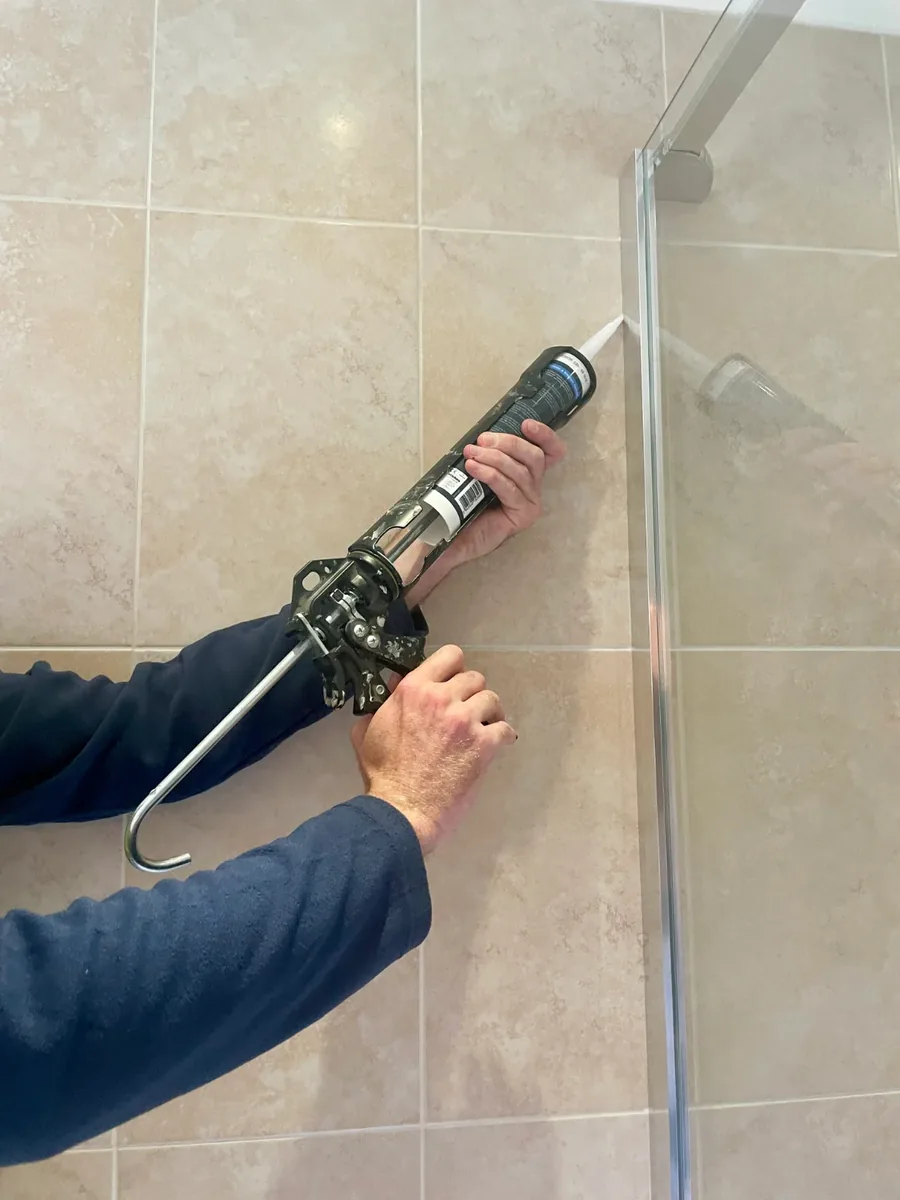
- Baths are filled first, then anti-fungal sanitary silicone is applied in a colour to suit.
- The joint is finished neatly and we explain when it can get wet.
How to prepare
- Let us know about parking restrictions
- Let us know if you’ve seen damp or leaks
- Mention any tricky access
Getting a quote
We don’t publish a price list, because every job is different. Instead, your job gets its own clear quote. To get started, call 0345 464 0079 or drop us an email.
Read more
What bathroom resealing looks like in St Ives
Hard water is the norm across most of the South East, so limescale builds up on sealant, grout and fittings, and it has to be cleaned off before new sealant goes in.
For site and facilities teams at buildings such as St Ives Primary & Nursery School, its toilets, changing areas and kitchens need their sealant renewed like any other building’s.
St Ives is in Hampshire. Our applicators cover bathroom resealing for homes and businesses in St Ives and the surrounding area, as part of our work across Hampshire. Our Hampshire coverage runs to 683 places, St Ives among them. Southampton is on our list too, about 20 miles from St Ives.
Here we cover the BH24 postcode area for bathroom resealing. Bathroom resealing is available to properties on Compton Beeches, Post Office Lane and Azalea Close. Nearby, we also carry out bathroom resealing in Ashley Heath (1 mile west), Avon Castle (1 mile south-east), St Leonards (1 mile south-west) and Matchams (1 mile south). We also work in nearby towns such as Totton (15 miles east), Lymington (13 miles south-east), New Milton (9 miles south-east), Barton on Sea (10 miles south-east), Ashley (10 miles south-east) and Milford on Sea (13 miles south-east).
Landmarks near St Ives
In St Ives, that means homes and buildings near Ringwood School, Ringwood Waldorf School and Avon Heath Country Park and the streets around them. Nearby you will also find St Leonard's Hospital (1.8 miles south-west). For a walk, there’s Blashford Lakes and Linbrook Lake.
Your questions about bathroom resealing in St Ives
Is bathroom resealing in St Ives guaranteed?
Every job comes with our one-year guarantee, wherever it is. We are also fully insured and ARBOMaster approved.
Can you do bathroom resealing in St Ives?
Yes, St Ives is within the area we cover. We work across London and the South East. Just call 0345 464 0079 or drop us an email with a few details of the job.
Can I do it myself?
For a simple, easy-to-reach joint, a careful DIYer can do a reasonable job. The usual mistakes are sealing over old sealant, sealing a damp joint and using too much.
Where are you based?
Our base is in Crawley, West Sussex, and we work across South East England, London and Scotland.
Can landlords and businesses book you?
Yes, we do. We work in homes, commercial premises and hotels.
Will the old sealant be removed?
Yes. Sealing over old sealant is the main reason resealing fails early, so we never do it.
Can new silicone go straight over the old?
No, never. Sealing over the top looks fine for a few weeks, then lifts, because silicone does not bond to silicone. Every trace of the old bead is removed first.
Will it make a mess?
No. The area is protected while we work and cleaned up afterwards.