
Glasgow · Scotland
Bathroom Resealing in Sandyford
Bathroom resealing across Sandyford and nearby, with old sealant always removed completely.
- A reseal done over the top of the old bead
- A bead that has pulled away from the tiles
- Water escaping at the shower enclosure
Questions from Sandyford
I’m in a tenement in Sandyford. Could worn sealant affect the flat downstairs?
It can. Tenement floors are usually timber, and water from a failed seal can find its way down to the flat below, and then the repair involves your neighbours too. Replacing tired sealant early is the simplest way to avoid that.
I let a flat near Charing Cross (Glasgow) station. Can you help?
Yes, rental work is part of what we do. You can drop us a line at info@mrmastic.co.uk with the address and a few details, and we will give you a fixed price before work begins.
Will there be a smell?
It depends on the product. Some products have a noticeable smell, others very little.
What colours of sealant can you use?
You are not limited to white: white, clear and colours to suit tiles and worktops. We can help you pick when we quote.
Do you remove the old sealant?
Yes, every time. New sealant won’t bond properly to old, so any old material comes out before anything new goes in.
Do I need to be at home?
That depends on where the joints are. For work indoors, someone needs to let us in.
Do you reseal kitchen worktops and sinks too?
Yes. Next to the sink we use a food-safe product where it’s needed.
What information do you need?
The location, the problem and the rough size of the job. If you can, email a few pictures.
Bathroom resealing in Sandyford
Homes in Sandyford have the same weak spots as anywhere else: bath edges, tray joints, basin backs and kitchen upstands. Each one is stripped, cleaned and dried before new silicone goes in. We work on kitchen worktops & upstands, basins & vanity units and wet rooms, and the jobs we see most are water escaping at the shower enclosure and gaps between the worktop and the wall.
From stone-built tenements to new flats and suburban houses, Sandyford is in a city with every kind of home. Scottish water is generally soft, so limescale is less of a problem than in hard-water areas, but mould still grows into sealant and grout in a steamy bathroom.
All of our work is guaranteed for twelve months, in Sandyford and everywhere else we cover.
- Location
- Sandyford (G3, G2, G4)
- Wider area
- Glasgow
- Cover
- A year, on every job
- Quote
- A clear price before we start
- info@mrmastic.co.uk
- Page updated
- 26 October 2026
How the visit works
Once we’re on site, we check the joints match what you told us. If we find something unexpected, we talk it through with you first. After that, the work takes half a day or less for one room, longer when the kitchen is included. For a tenement in Sandyford, work inside your flat is between us and you, while shared parts may need the factor or neighbours to agree. It helps to know which it is when you get in touch.
- We start by protecting the area and stripping out the old bead.
- The joint is cleaned, degreased and treated for mould.
- Once it’s dry, any bath is filled so the bead is laid with it at its heaviest.
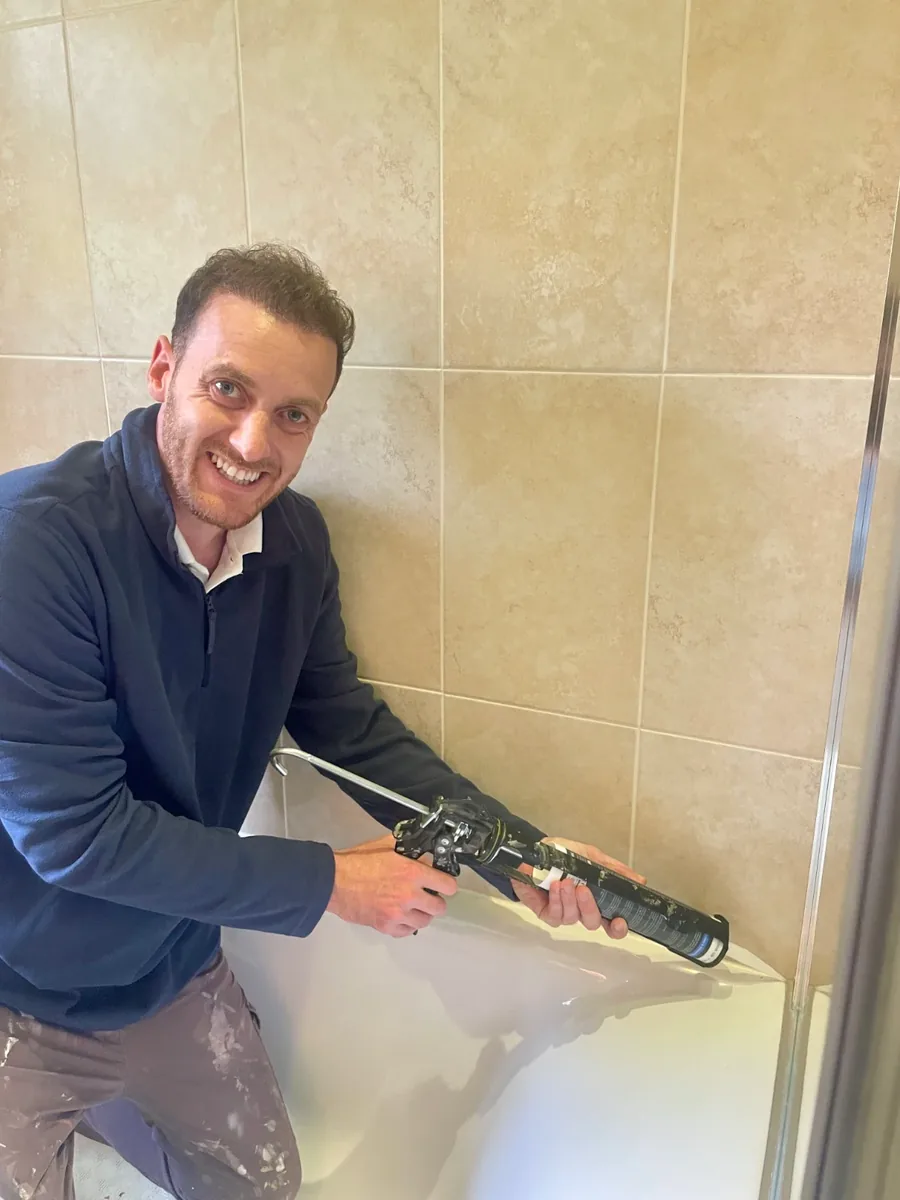
- We apply anti-fungal sanitary silicone in one even bead and tool it neatly.
- We tidy up and give you the cure time, generally around 24 hours.
Getting ready for the visit
- Move anything stored near the joints
- Let us know about parking restrictions
- Plan for the work area to be out of bounds to pets and children
Getting a quote
For a quick quote, get us on the phone, or email us if that’s easier. Tell us about the joints that need doing and we will talk you through the work before giving you a price.
Read more
Signs you need bathroom resealing in Sandyford
Silicone needs a clean, dry surface without any grease to stick to. Soap residue, oils and leftover silicone film all get in the way, so a rushed job can start to lift early.
The most common problems we see are:
- A reseal done over the top of the old bead
- Mouldy sealant that has gone black
- Shrunken sealant along the back of a worktop
- Cracked, shrunken or lifting silicone
If you look after a building such as Glasgow Gaelic School, its toilets, changing areas and kitchens need their sealant renewed like any other building’s.
Questions to ask before booking
- Is the old sealant removed completely?
- Whether you can choose the colour
- What product goes in the joint
- Who turns up on the day
For landlords and businesses
Failed sealant is one of the commonest items on a check-out report. Several properties can be quoted together.
Water getting past a failed joint can damage the building, which matters even more when someone else lives there. Resealing at the right time is simple maintenance that we can handle for you.
Also near Sandyford
Also in Sandyford
Looking after it afterwards
Once the sealant has cured, a few habits help it last:
- Run the extractor fan during and after every shower
- Clean with a mild bathroom cleaner and a soft cloth
- Don’t leave water standing on kitchen joints
- Never pick at the silicone with a blade
Keep bottles and razors off the sealant line, as they hold water against it. A quick squeegee after showering keeps water from sitting on the joint.
Worktop joints fail quietly. Water gets behind the upstand and into the edge of a laminate worktop, and the board underneath can swell. A reseal in time can save the worktop.
Bathroom resealing around Sandyford
There are hotels and other places to stay in and around Sandyford. Hotel bathrooms are part of our work as well as homes, and can be done room by room. Private landlords in Scotland must be registered and meet the Repairing Standard, which covers keeping fixtures and fittings in a reasonable state of repair. Failed sealant around a bath or shower is worth sorting between tenancies.
Rented homes near Charing Cross (Glasgow) station change hands often, and a reseal between tenants is a quick way to make the bathroom and kitchen look cared for. For an older house near a landmark such as St Vincent Parish Church, walls and floors in older homes can move, and sealant and grout show it first.
Sandyford is about 1 mile north of Glasgow, in Glasgow. We carry out bathroom resealing for homeowners, landlords and businesses in Sandyford and nearby, as part of our work across Glasgow. Sandyford is one of 183 towns and villages in Glasgow where we work for bathroom resealing.
Work in G3, G2 and G4 works the same way as everywhere else we cover. We cover properties on Kent Road, Bath Lane and Cliff Road. Neighbouring places we cover for bathroom resealing include Anderston (1 mile north-east), Kelvingrove (1 mile north-west), Garnethill (1 mile north-east), Blythswood Hill (1 mile east) and Finnieston (1 mile west). Further out, we also cover Langside (3 miles south), Yoker (4 miles north-west), Mount Florida (3 miles south), Hillpark (4 miles south), Temple (3 miles north-west) and Merrylee (4 miles south).
Around Sandyford
In Sandyford, that means homes and buildings near The Hengler's Circus pub, College of Piping and Lorne Street Primary School, among other places. Also close by are Kelvingrove Park (0.5 miles north-west), Glasgow University Library (0.8 miles north-west) and St Vincent Street Church (within half a mile east). Sandyford has its own railway station: Charing Cross (Glasgow) station. Nearby you will also find Chinatown (0.7 miles north-east) and Glasgow Dental Hospital and School (within half a mile north-east). The countryside around Sandyford includes Hogganfield Loch.
DIY sealant or a professional job?
A DIY attempt doesn’t rule out a professional job. We cut it out and start again, so tell us about it when you ask for a quote.
Overfilling a joint is a classic DIY mistake. A heavy bead looks messy and copes badly with movement, and the joint depth matters as much as the finish.
How the job changes by surface
Shower trays & enclosures
There are generally two jobs in a shower: the tray-to-wall joint and the enclosure joints. Both take water every day, so both are resealed with anti-fungal sanitary silicone.
Basins & vanity units
Vanity units have long, worktop-style joints against the wall. If water gets in, the cabinet underneath can swell, so the joint is sealed in one unbroken line.
What we cannot put right
Some problems need a builder, plumber or other trade rather than us:
- Leaks from a shower valve, waste or pipework (a plumber’s job)
- A bath or tray that moves because it is not properly supported
- A tray or bath that’s cracked through
Not sure which it is? You can drop us a line at info@mrmastic.co.uk and we’ll tell you honestly.
Surfaces we seal
- Shower trays & enclosures
- Wet rooms
- Basins & vanity units
- Sinks & splashbacks
- Kitchen worktops & upstands
- Baths