
West Sussex · England
West Dean External Mastic
Sealing brickwork movement joints, render, cladding and façade joints for homeowners, landlords and businesses in West Dean. Fully insured, ARBOMaster approved and guaranteed for a year.
- Joints pointed up with cement by mistake
- Weathered mastic that no longer stretches
- Joints where the bead has come unstuck
West Dean: your questions answered
Can you do external mastic in West Dean?
Yes, West Dean is within the area we cover. Our work covers London and the South East. Just phone 0345 464 0079 or send us an email with a few details of the job.
I let a flat near Fishbourne station. Can you help?
Yes. We work for landlords and letting agents as well as homeowners, and several properties can go on one quote. You can call 0345 464 0079 or email us with the details for a clear quote.
Do you do commercial work?
Yes. We work in offices, washrooms, hotels and other commercial premises. Working times can be discussed when we quote.
What should I tell you?
Only a few details: where it is, what you’ve noticed and how we reach it. After that, simply phone 0345 464 0079 or drop us an email.
Is it OK to fill a movement joint with cement?
No, not where the gap is a movement joint. Pointing it stops it working. We’ll reseal it with a flexible sealant.
How often do external joints need resealing?
That varies with the weather the wall faces, how much it moves and the sealant used. Treat it as a maintenance item and look at it yearly.
Is the work guaranteed?
Yes. Every job comes with our 12-month guarantee.
Why is there a gap in my brick wall?
Walls move with heat, cold and moisture, so long walls have planned gaps to take that movement. The gap is sealed with a flexible sealant over backing rod.
External mastic in West Dean
Getting the depth right is half the job. Closed-cell backing rod sets the depth and stops the sealant sticking to the back, leaving it bonded to two faces so it can move with the wall. We work on façade panels, render & cladding joints and brickwork movement joints, and the jobs we see most are movement joints filled with mortar instead of sealant and failed sealant between panels on a façade.
Around West Dean, older buildings can be stone, brick or timber-framed, many with extensions added later. Where one material meets another is where water usually gets in, and they need the right sealant at the right depth.
The work is guaranteed for twelve months. If something is not right with it in that time, tell us and we will put it right.
- Where
- West Dean (PO18)
- Region
- West Sussex
- Cover
- 12 months on all our work
- Quote
- A clear price before any work starts
- Call
- 0345 464 0079
- Last updated
- 26 October 2026
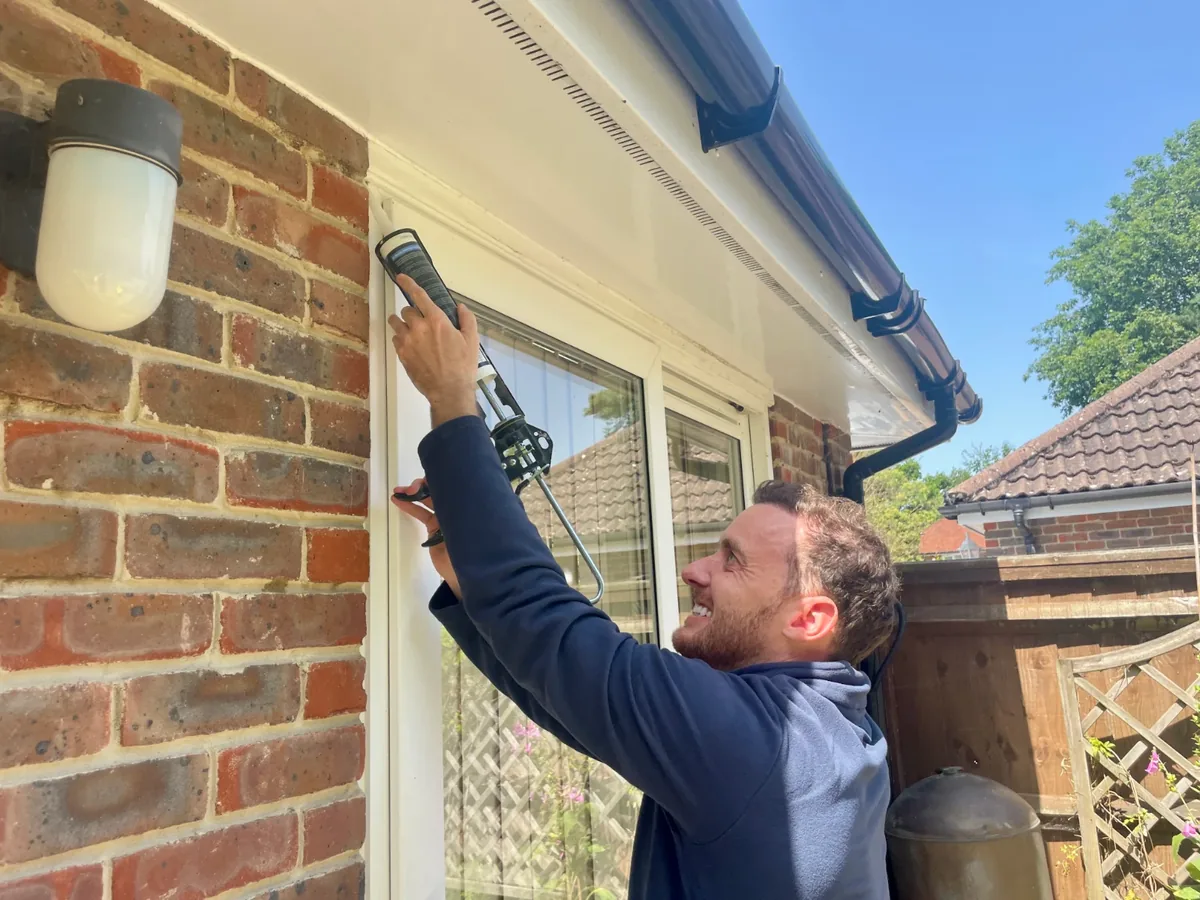
Why it’s worth doing now in West Dean
Done well, a resealed joint is a neat, straight line that suits the wall. A rushed bead with no backing looks untidy and does not last. In a small place like West Dean, homes can be exposed to wind and rain, which finds any gap, and older walls, once damp, take a long time to dry.
Rather than a set price list, we look at what your job involves: how many joints, what’s in them now and how we reach them. You will know the price before we begin.
What you get with us
- Homes, businesses and hotels
- Colour agreed with you before any work starts
- Fully insured
- Sealant colour chosen to suit
See our cost guide and our reviews.
Work for landlords, hotels and businesses
Landlords and agents in West Dean can book us as well as householders. Resealing between tenancies is a simple way to keep a property in good order.
Letting agents often deal with us directly. Tell us the address, the job and how access works.
West Dean buildings and the weather
With historic houses such as West Dean House (about 0.1 miles north-east) nearby, there’s older building stock in the area around West Dean as well as newer homes. Where a home is older, older walls and rooflines need a sealant that moves with them and suits the material. London and the South East are among the drier parts of the UK, yet outdoor joints still have to be sealed dry, so jobs are booked with the weather in mind.
Managing a site like West Dean CofE Primary School? Then its movement joints, gutters and trims need looking after like any other building’s. Rented homes near Fishbourne station change hands often, and split movement joints are easy to miss on a rental until damp shows inside.
West Dean is about 4 miles north of Chichester, in West Sussex. We carry out external mastic for homes and businesses in West Dean, as part of our work across West Sussex. Our West Sussex coverage runs to 371 places, and West Dean is one of them. There’s also a page for Portsmouth, roughly 15 miles from West Dean.
Work in PO18 works the same way as everywhere else we cover. Other places close to West Dean include Singleton (1 mile east), Charlton (2 miles east), East Dean (3 miles east), Cocking (3 miles north) and Bepton (4 miles north). Within a short drive, we also cover Bognor Regis (9 miles south-east), Chichester (4 miles south), Selsey (12 miles south), Littlehampton (13 miles south-east), Emsworth (8 miles south-west) and Rustington (13 miles south-east).
Landmarks near West Dean
The closest station to West Dean is Fishbourne station, roughly 4.8 miles south of the centre. Well-known places in the area include Chichester Castle (4.5 miles south) and Museum of Gardening (within half a mile north-east). Open spaces near West Dean include Levin Down and Kingley Vale National Nature Reserve.
When to call us in West Dean
Buildings move more than people expect. Brickwork grows a little over the years, blockwork and concrete shrink, and all of it moves with heat and moisture. All of that ends up in the joint sealant.
Keep an eye out for any of the following:
- Joints where the bead has come unstuck
- Failed seals between different materials
- Hard, crazed mastic that has stopped moving
- Leaking joints around cladding and façade panels
If you live in an older home near The Parish Church of St Andrew, an extension built onto an older house moves differently, and the joint between them takes the strain.
Comparing quotes
- Is VAT in the price?
- How the surfaces are prepared before sealing
- What happens if the job turns out different
- Is the old sealant removed completely?
Surface by surface
Concrete and blockwork
Concrete faces can be dusty and porous, so cleaning and priming matter. A primer goes on where the product requires one before sealing.
Cladding and façade panels
If the façade has a specified sealant, that’s what we use, or one the system allows. Send us any details you have about the façade.
How it works
On the day, there’s very little for you to do. Show us the job and we’ll take it from there. The job generally takes a few hours to a few days, depending on the length of joint and the access, including the tidy-up. Somewhere as small as West Dean, access is often the only tricky part. If the job is outside, mention outbuildings, exposed walls and how to reach them.
- We inspect the joints and agree which need resealing and how they’ll be reached.
- The old mastic and anything lodged in the joint is removed.
- We clean both faces of the joint and prime them where the product calls for it.
- Closed-cell backing rod is fitted to set the depth and stop three-sided bonding.
- The new sealant, chosen to suit the brick or render, is applied and tooled to a neat finish.
Getting ready for the visit
- Clear the area around the work
- Let us know about stairs, lifts or work at height
- Plan for the work area to be out of bounds to pets and children
How to get a quote
Asking for a quote is easy: tell us what needs doing and where, and roughly how big it is. Photos by email help us understand the job.
Read more
Other services in West Dean
Aftercare tips
Simple care keeps the joints in good condition. Our advice:
- Do not let climbing plants root in the sealant
- Wash walls gently around the sealant
- Never let anyone fill a movement joint with mortar
- Leave the joints unpainted unless we have said otherwise
Give the sealant the cure time we tell you before anything rubs against it. The surface skins over quickly, but full cure takes longer.
Water getting behind cladding or render can go unnoticed for a long time. By the time there’s a damp patch, the damage can be well established.
Can I do it myself?
Sealing over old silicone is the commonest DIY error. New silicone won’t bond to old, so it lifts and traps water and mould underneath. All the old material has to come out first.
A DIY attempt doesn’t rule out a professional job. We cut it out and start again.