
Essex · England
Mill Street Bathroom Resealing
Baths, showers and worktops in Mill Street need attention? We remove the old material, prepare the joints and seal them properly.
- Splits where the tray meets the wall
- Mouldy sealant that has gone black
- Damp behind the bath or under the tray
Landlord and commercial work in Mill Street
Landlords and letting agents in Mill Street can book us as well as homeowners. Sealant work between tenants is a simple way to keep a property in good order before the next move-in.
Water getting past a failed joint can damage the building, which is a bigger problem in a rented property. Resealing at the right time is simple maintenance that we can handle for you.
Bathroom resealing for homes and businesses in Mill Street
Before a bath is sealed, it’s filled with water. The weight settles the bath to its lowest point, so the new joint isn’t pulled apart the first time it’s used. It’s a small step that rushed reseals tend to skip. If you’re dealing with leaks into the floor or ceiling below and leaking joints on a shower screen, we can put it right.
Somewhere as small as Mill Street, homes tend to be cottages, farmhouses or converted buildings, with some newer houses too. Movement in older walls and floors tends to show first as cracked grout or split sealant.
Our work is backed for twelve months.
- Where
- Mill Street (CO6)
- Wider area
- Essex
- Cover
- One year on every job
- Quotes
- Quoted before any work starts
- Phone
- 0345 464 0079
- Last updated
- 26 October 2026
Your questions about bathroom resealing in Mill Street
Will you come out to Mill Street?
Yes. Mill Street is within the area we cover, which takes in towns, villages and rural addresses. Our work covers London and the South East. Let us know about access, parking and anything unusual about getting there when you book.
Is bathroom resealing in Mill Street guaranteed?
All our work, in Mill Street and everywhere else, comes with a 12-month guarantee. We’re also fully insured and ARBOMaster approved.
Do the sealants smell?
That depends on the sealant. Some smell for a while, some hardly at all, and any smell fades as they cure.
Do you remove the old sealant?
Yes, every time. New sealant won’t bond properly to old, so any old material comes out before anything new goes in.
Can I add another job to the visit?
Yes. Just list everything you need and we will quote it together.
How long does the new silicone need before I use the shower?
We give you the cure time before we leave, and it’s normally around 24 hours. Using it sooner can damage the bead.
Can you just seal over the old silicone?
No. A bead laid over old silicone soon starts to come away. Every trace of the old bead is removed first.
What sealant do you use?
It depends on the joint: anti-fungal sanitary silicone in wet areas, and other sealants where joints move or face the weather. Brands we use include Arbo and Everbuild.
DIY versus a professional finish
Some jobs are best left to a professional: high-level joints, fire-rated gaps, external movement joints and big jobs call for the right materials, safe access and experience.
The difference is mostly in the preparation and the product. Joints are cleaned back to sound surfaces and dried, and the sealant is chosen for how the joint moves and where it is, and the work is guaranteed for a year.
Signs you need bathroom resealing in Mill Street
Sealing over old silicone is one of the commonest mistakes we find. Fresh silicone can’t grip the old bead underneath, so it lifts, lets water in and traps mould underneath.
The problems people generally mention when they call are:
- Black mould in the silicone that won’t clean off
- Leaking joints on a shower screen
- Water getting behind the bath panel
- A bead that has pulled away from the tiles
For site and facilities teams at buildings such as Stoke-by-Nayland Church of England Primary School, washroom and kitchen sealant there needs the same care as at home, and schools and businesses are part of our work as well as homes.
Comparing quotes
- Whether the sealant suits the joint
- Who does the work, and how experienced they are
- What guarantee comes with the work
- How long to leave it before use
How it works
We bring everything the job needs with us. Once we’ve agreed what’s being done, the area is protected and the work begins. Most jobs take half a day or less for one room, longer when the kitchen is included. For a village or hamlet like Mill Street, the journey is planned in advance: tell us about narrow lanes, gates, long drives and where we can park. We bring what the job needs, so it can be finished in one trip where possible.
- We look at every joint first and check for movement or leaks.
- Every trace of the old bead is removed, including the thin smear on the tiles.
- The joint is cleaned, degreased and treated for mould.
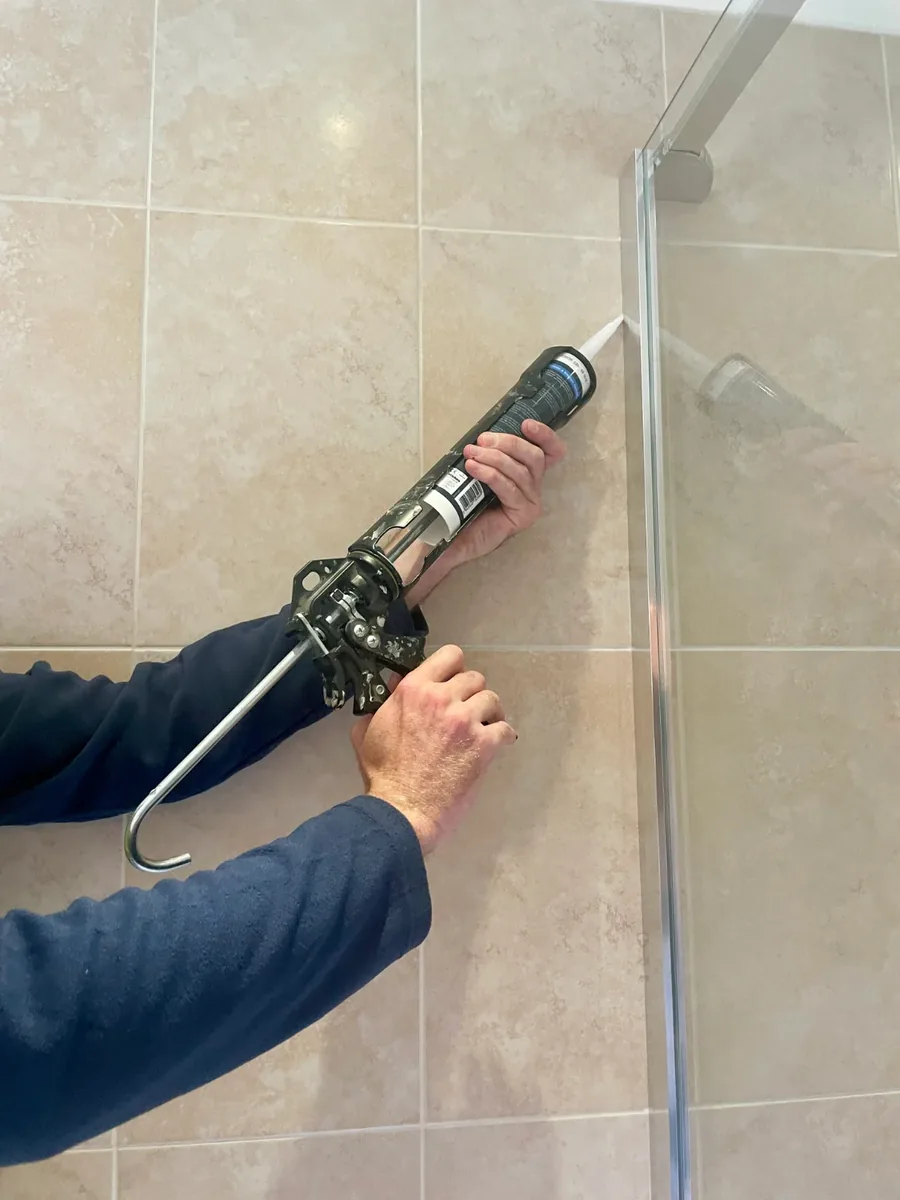
- With the joint dry, and any bath loaded with water, a single bead of anti-fungal silicone is applied.
- The bead is tooled smooth and you’re told the cure time, usually around 24 hours.
Before we arrive
- On commercial sites, let us know about site rules
- Move anything stored near the joints
- Mention any parking rules near the property
How to get a quote
The more we know about the job, the more useful the quote. Tell us where the job is, what’s wrong and how much there is, and email pictures if that is easy.
Related advice
What happens if it’s left?
Sorting it now is quick: the work takes around two hours for one bath or shower, longer for a whole bathroom. Wait for a leak and you may be looking at panels off, drying out and redecorating too. Where a wall is exposed, as many are in small places like Mill Street, wind-driven rain gets into any failed joint, and damp in older walls is slow to dry out.
The cost reflects the work involved, not guesswork. That is why we ask about the job first.
Why us?
- A 12-month guarantee on all work
- White, clear, grey or another colour, product permitting
- Trusted Arbo and Everbuild sealants
- Old sealant always removed completely
When it isn’t the sealant
New sealant cannot fix everything, and we’d rather say so up front. Sealant will not put right:
- Cracked or missing grout between tiles (that’s regrouting)
- Cracks in the tray itself rather than the joint
- Leaks from a shower valve, waste or pipework (a plumber’s job)
If in doubt, phone 0345 464 0079 or send us an email and we will say what we think before booking.
Joints and surfaces we work on
- Basins & vanity units
- Sinks & splashbacks
- Baths
- Shower trays & enclosures
- Kitchen worktops & upstands
- Wet rooms
Also near Mill Street
Other services in Mill Street
What bathroom resealing looks like in Mill Street
Most of the South East has hard water, so limescale builds up on sealant, grout and fittings, and it has to be cleaned off before new sealant goes in.
If you live in an older home near Church of St Mary, timber floors under older bathrooms flex, so joints need a sealant that moves with them.
Mill Street is in Essex. Our applicators cover bathroom resealing for homes and businesses in Mill Street, as part of our work across Essex. Our Essex coverage runs to 644 places, Mill Street among them. We also work in Chelmsford, around 25 miles away.
Here we cover the CO6 postcode area for bathroom resealing. Whether your property is on Mill Street and Mill Lane or anywhere close by, we can help. Within a short drive, we also cover Colchester (8 miles south), Camulodunum (8 miles south), Halstead (12 miles west), Greenstead (8 miles south), Tiptree (14 miles south-west) and Wivenhoe (10 miles south).
What’s near Mill Street
Typical jobs here are in homes near Bells Corner pub, among other places. Well-known places in the area include Severalls Hospital (5.7 miles south) and Lindsey Castle (4.1 miles north). For a walk, there’s Arger Fen.
Different surfaces, different methods
Basins & vanity units
Basins take less water than showers, but the joint behind them is splashed every day. Corners behind basins are where mould tends to start, and we treat it exactly as we would a bath.
Sinks & splashbacks
Where a splashback meets the worktop, there’s a joint that catches every splash. We renew it in clear, white or a matched colour.