
Greater London · England
Sand mastic for sash & case windows in Chalk Farm, Greater London
Traditional burnt sand mastic around sash and case windows and doors in stone and brick for Chalk Farm, backed by a 12-month guarantee. Ask us for a quote.
- Mastic worn away on windows facing the weather
- Modern sealant on a period surround
- Draughty sash windows at the surround
Your questions about sand mastic in Chalk Farm
Is parking a problem for a job in Chalk Farm?
It can be, so it helps to tell us about permits, visitor bays or off-street space when you book. That way the visit can be planned around it.
Do you work for landlords with property near Kentish Town West station?
Yes. We work for landlords and letting agents as well as householders. Just phone 0345 464 0079 or drop us an email with the address and what needs doing, and we’ll give you a clear quote.
Do you guarantee sand mastic work?
Our 12-month guarantee applies to all our work.
Are you ARBOMaster approved?
Yes. We hold ARBOMaster approved applicator status and we are fully insured too.
Is sand mastic better than silicone for my windows?
Sand mastic normally suits period timber windows best. On modern frames, we’d normally use a flexible sealant.
How much does sand mastic cost in Chalk Farm?
There’s no set price, as it depends on the job: its size, the old material, access and the product needed. You’ll get a clear quote before work begins.
Can sand mastic be painted?
The usual advice is to leave sand mastic unpainted. If you are redecorating the window, ask us first and we’ll advise.
Do you offer different sealant colours?
Usually, yes. White, clear and grey are common, and other colours are available, and we agree the colour with you before work begins.
Sand mastic in Chalk Farm, done properly
Sand mastic has long been used to fill the joint between timber frames and masonry. It’s made from sand and a linseed-oil-based binder and built up by hand. On period homes, it looks right where silicone wouldn’t. If you’re dealing with mastic worn away on windows facing the weather and gaps where the frame meets the masonry, we can help, whatever the surface.
London homes have every kind of window, from timber sashes in period terraces to aluminium and uPVC in newer blocks. The mastic around them dries out and cracks with age, letting in draughts and water.
Every job comes with our one-year guarantee.
- Where
- Chalk Farm (NW5, NW1, NW3)
- Region
- Greater London
- Cover
- A year, on every job
- Price
- Quoted before any work starts
- Call
- 0345 464 0079
- Last updated
- 26 October 2026
Why it’s worth doing now in Chalk Farm
Cement-based fillers and modern sealants don’t always suit a period surround. Sand mastic matches what was there and that can be important for listed homes. Damp from a failed joint spreads quietly in older London brickwork and timber, and once it shows in Chalk Farm, the repair is bigger than a sealant job.
Leaving a failed joint usually makes the job bigger, not smaller, as water and mould keep getting in. If you’re unsure, phone 0345 464 0079 or drop us an email for an honest opinion and a quote.
Why book with us
- Full insurance on every job
- More than 20 years in sealant work
- We leave the area clean and tidy
- A 12-month guarantee on all work
Read what affects the cost or what customers say.
Windows and doors in Chalk Farm
In a converted house or block, who looks after the windows depends on the lease, so it’s worth checking before booking. Compared with the north and west, the South East gets less rain, though outdoor sealant still has to go onto a dry joint, so the forecast decides the day.
As a London address, Chalk Farm can be tricky for parking: tell us about permits, visitor bays or off-street space when you book. For site and facilities teams at buildings such as Haverstock School, larger buildings have plenty of frames, and the mastic around each one ages.
Chalk Farm is about 1 mile south-east of Hampstead, in Greater London. From the centre of Chalk Farm to the outskirts, we cover sand mastic for every kind of property, from flats and houses to offices and hotels. We cover 764 towns and villages across Greater London, large and small.
Postcode districts we cover here for sand mastic: NW5, NW1 and NW3. Whether your property is on Eton Road, Oval Road and Regal Lane or a nearby road, we can help. Main roads around Chalk Farm include the A5205, so getting to you is simple. Neighbouring places we cover for sand mastic include Kentish Town (1 mile east), Primrose Hill (1 mile south-west), Haverstock (1 mile west), Belsize Park (1 mile west) and Camden Town (1 mile south-east). Larger places within reach include London (4 miles south-east), Kensington (4 miles south-west), Shoreditch (3 miles east), Walthamstow (6 miles north-east), Hoxton (3 miles east) and Whitechapel (4 miles south-east).
Landmarks near Chalk Farm
Locally, jobs take us to homes and businesses close to Primrose Hill, Cecil Sharp House and The Fiddlers Elbow Public House. Other local landmarks include Holy Trinity and Saint Silas CofE Primary School (within half a mile east) and North Bridge House School (0.5 miles south-east). Chalk Farm has its own railway station: Kentish Town West station. Other landmarks nearby include Isokon Gallery (0.7 miles north-west) and O2 Centre (1.3 miles west). Green spaces nearby include Primrose Hill and The Long Water.
Nearby places to Chalk Farm
Also in Chalk Farm
How the job changes by surface
Timber door frames
Doors face weather and wear and the mastic can crack early. It’s renewed by hand.
Sash and case windows
A sash window’s box frame sits in the masonry opening. Sand mastic seals the joint round it.
When something else is needed
A few problems are outside what sealant work can do:
- Sash cords, weights and draught-proofing of the sashes
- Timber that has rotted
- Masonry that needs repairing
If you are not sure, just phone 0345 464 0079 or send us an email and we’ll give you a straight answer.
Joints and surfaces we work on
- Period & listed homes
- Tenement windows
- Sash and case windows
- Stone surrounds
- Timber door frames
- Brick reveals
What we do, step by step
We bring everything the job needs with us, so you do not need to buy or prepare anything. After a quick look at the joints together, the area is protected and the work begins. Most jobs take a few hours per window, depending on the condition of the joints. In Chalk Farm, flats, stairs and shared entrances are part of the routine. Mention any building rules, key holders or managing agents when you book.
- We check each window surround and the condition of the joint.
- We rake out the old mastic and clean the joint.
- Large voids are packed out.
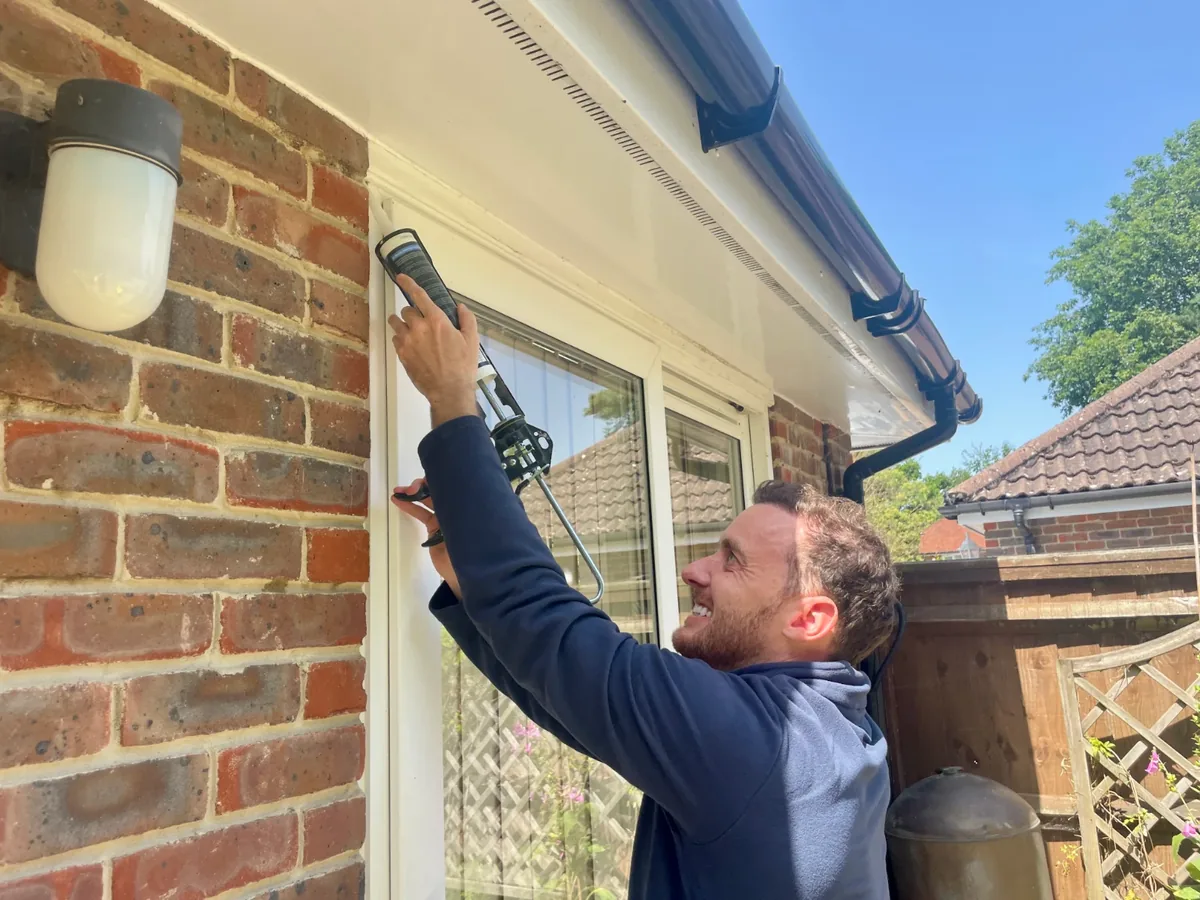
- New sand mastic is applied and shaped by hand.
- The finish is dressed neatly.
How to prepare
- For business premises, tell us about site rules or sign-in
- Let us know about parking restrictions
- For indoor joints, keep the area dry beforehand if you can
Get a quote
Asking for a quote is easy: let us know the job and the location. Photos by email help us understand the job, and we’ll take it from there.
Read more
Aftercare tips
To keep the joints looking good and working properly:
- Ask a joiner to look at soft timber first
- Clear gutters so water doesn’t pour onto the windows
- Inspect the joints round the windows every year or so
- Leave the new mastic unpainted
Don’t run silicone over the new mastic. If you see a crack, ask us to take a look rather than patching it.
Gaps round a sash box let in draughts and rain. Left, the gap tends to get bigger.
Do you need sand mastic in Chalk Farm?
Timber swells and shrinks with the weather. The movement cracks the mastic little by little.
Any of these means the joints need attention:
- Draughts and rain around sash boxes
- Cracked mastic round a front door frame
- Patchy fillers round a sash window
- Modern sealant on a period surround
For an older house near a landmark such as St Silas Church, replacement windows fitted into old openings often leave uneven gaps that need backing and a flexible joint.
Questions to ask before booking
- What guarantee comes with the work
- Whether VAT is included
- What product goes in the joint
- Whether they’re fully insured
Should I try it myself first?
A DIY attempt doesn’t rule out a professional job. We cut it out and start again, so tell us about it when you ask for a quote.
Sealing over old silicone is the commonest DIY error. New silicone won’t bond to old, so it peels away and traps moisture behind it. All the old material has to come out first.