
Oxfordshire · England
Turville Fire Rated Sealant
Intumescent and fire-rated sealant around gaps, frames and service penetrations for householders, landlords and businesses in Turville. ARBOMaster approved applicators, fully insured, with a 12-month guarantee.
- Open holes round services passing through fire walls
- New service routes left unsealed after building work
- Gaps flagged on a fire risk assessment
What sealant work cannot fix
Sealant is not the answer to every problem, and we’d rather say so up front. It won’t solve:
- Fire risk assessments, which need a qualified assessor
- Fire doors that need new seals, closers or hardware
- Large holes that need a different fire-stopping system
Not sure which it is? You can call 0345 464 0079 or send us an email and we’ll tell you honestly.
What we seal
- Door frames
- Flats & HMOs
- Pipe & cable gaps
- Linear gaps
- Plasterboard & masonry
- Service penetrations
About our fire rated sealant in Turville
Filling a fire-stopping gap with standard silicone or caulk does not make it fire-rated. Anything unsuitable comes out first and reseal with a fire-rated product tested for that kind of gap. Typical jobs include old fire sealant that has split or come away and gaps left after a refit or conversion, on door frames, flats & HMOs and linear gaps.
In a village or hamlet like Turville, commercial work is more likely to be a pub, a farm shop, holiday lets or a village hall than an office block. They all have washrooms, kitchens and service openings that need the right sealant.
We stand behind the work with a one-year guarantee.
- Place
- Turville (RG9)
- Wider area
- Oxfordshire
- Guarantee
- 12 months on all our work
- Quotes
- A clear price before work begins
- Call
- 0345 464 0079
- Last updated
- 26 October 2026
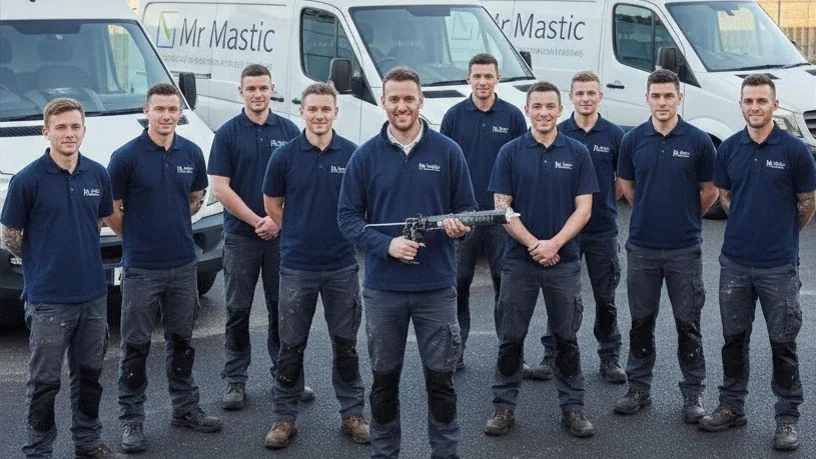
Fire rated sealant in Turville: local notes
In England, the Regulatory Reform (Fire Safety) Order 2005 requires a fire risk assessment for workplaces and for the common parts of blocks of flats, which is often where open fire-stopping gaps are first noticed. We apply fire-rated sealant to the assessor’s or designer’s specification and the product’s tested details.
Schools such as Ibstone CofE Primary School are buildings too, and gaps opened by contractors for new cabling are a common finding in schools and offices. For buildings such as Church of St Mary, gaps around pipes and cables are worth checking after any building work there.
Turville is about 6 miles north-west of Marlow, in Oxfordshire. Our applicators cover fire rated sealant for homes and businesses in Turville and the surrounding area. Our area takes in 443 places across Oxfordshire, large and small. You can also see our page for Reading, roughly 12 miles from Turville.
Here we cover the RG9 postcode area for fire rated sealant. Streets in the area include Holloway Lane and School Lane. Neighbouring places we cover for fire rated sealant include Fingest (1 mile east), Cadmore End (1 mile north-east), Little Frieth (2 miles east), Frieth (2 miles east) and Bolter End (2 miles east). Within a short drive, we also cover Didcot (15 miles west), Thame (10 miles north), Henley-on-Thames (6 miles south), Benson (9 miles west), Chinnor (6 miles north) and Tilehurst (12 miles south-west).
What’s near Turville
We work in homes and buildings around The Bull And Butcher pub and the streets around them. Other landmarks nearby include Marlow Community Hospital (6 miles south-east). Open spaces near Turville include Warburg Nature Reserve and Bald Hill.
Work for landlords, hotels and businesses
We also work for property managers and facilities teams. Several sites can be quoted together.
For anyone letting property in or around Turville, several properties can go on one quote. Just tell us the addresses and what each one needs, and pictures by email help.
Turville: your questions answered
Is Turville in your area for fire rated sealant?
Yes, Turville is within the area we cover. We work across London and the South East. Just phone 0345 464 0079 or email us with a few details of the job.
Is fire rated sealant in Turville guaranteed?
Every job comes with our 12-month guarantee, wherever it is. We are also fully insured and ARBOMaster approved.
Do I have to be there?
Access is agreed with you when the job is booked. For inside work, that normally means someone being in.
Which products do you use?
Quality sealants from brands including Arbo and Everbuild, chosen to suit the joint. We’ll tell you what we are using and why.
Do you carry out fire risk assessments?
No. That is for a fire risk assessor, designer or building control. Our job is applying the sealant to their specification.
Can you do several jobs on one visit?
Yes, and it often makes sense. Combining jobs makes good use of the visit.
What information do you need?
Where the job is, what the problem is and roughly how big it is. Photos by email help too.
How long will you be here?
A typical job takes from a few hours to a few days, depending on the number of gaps and the access. Your quote will say how long we expect yours to take.
The process
Good joint work is mostly preparation, and we do not rush it. Joints are cleaned back and dried before anything new goes in. In total, it generally takes from a few hours to a few days, depending on the number of gaps and the access. Somewhere like Turville needs a little journey planning: tell us about narrow lanes, gates, long drives and where we can park. We bring what the job needs, so it can be finished in one trip where possible.
- We start with the survey or action list, checking the size and surfaces of every gap.
- Anything that isn’t fit for the job comes out, and the gap is cleaned.
- Backing or fill is fitted where the product’s tested detail calls for it.
- Fire-rated or intumescent sealant is applied to the right depth and tooled.
- We record the locations and products used for your records.
How to prepare
- Tell us about any water getting in
- Tell us if parking is tricky
- Tell us about any previous sealing or DIY attempts
Getting a quote
We do not publish a price list, as no two jobs are quite the same. Instead, we give you a clear quote for your job. To get started, phone 0345 464 0079 or email us.
Advice
How the job changes by surface
Flats and HMOs
Working in occupied flats needs some planning. We agree access to each flat and the common parts before we start so residents know what to expect.
Masonry and concrete
For masonry and concrete, we use a product tested in that substrate. The gap is cleaned of dust first so the seal has something sound to bond to.
Looking after it afterwards
To keep the joints looking good and working properly:
- Report cracked or damaged seals as soon as you notice them
- Take photos of fire stopping before ceilings or boxing go back
- Store the list of sealed gaps with your building paperwork
- Check risers, ceiling voids and cupboards during building checks
Do not drill through or remove a fire seal without putting it back properly. If you need new services through a sealed wall, plan the fire stopping as part of the job.
If a fire risk assessment has flagged a gap, do not leave it for the next one. Have it sealed, then keep the record so the item can be closed.
Towns and villages near Turville
What else we do in Turville
How we quote for fire rated sealant
Every job gets its own quote. This is what makes a difference:
- Whether old sealant or filler has to be cut out
- When we can work, for business premises
- How many areas need sealing
- The size of the job
No two jobs are quite the same, so we quote each one individually. The number of joints, how easy they are to reach and the sealant needed all play a part.
What to tell us for a quote
You don’t need to know the technical terms. It helps if you can tell us:
- What the problem is, such as mould, gaps, leaks or cracking
- Any previous sealing or DIY work
- How we’d reach the joints
- Roughly how big the job is
For a quick quote, get us on the phone, or email us if that is easier. Tell us about the joints that need doing and we’ll talk you through the work and give you a clear quote.
Should I try it myself first?
A DIY attempt does not rule out a professional job. We cut it out and start again.
Sealing over old silicone is the commonest DIY error. New silicone won’t bond to old, so it peels away and traps moisture behind it. All the old material has to come out first.