
West Berkshire · England
Sand mastic for sash & case windows in Great Lea Common, West Berkshire
Traditional burnt sand mastic around sash and case windows and doors in stone and brick for Great Lea Common, backed by a 12-month guarantee. Call for a quick quote.
- Mastic that needs renewing before redecorating
- Draughty sash windows at the surround
- Failed mastic on an exposed elevation
Sand mastic in Great Lea Common
Sand mastic suits most period window surrounds. Newer frames normally get a flexible sealant instead, and we will talk through which suits your home. If you have gaps between timber frames and stone or brick and cracked mastic round a front door frame, we can put it right, whatever the surface.
Outdoor sealant needs dry, clean surfaces, so work on frames around Great Lea Common is planned for dry weather. Tell us about access to every side of the house, including upper-floor windows.
A 12-month guarantee comes with the work, just as it does everywhere we cover.
- Place
- Great Lea Common (RG7)
- Wider area
- West Berkshire
- Cover
- 12 months on all our work
- Quote
- A clear price before work begins
- Call
- 0345 464 0079
- Page updated
- 26 October 2026
Work for landlords, hotels and businesses
We also work for businesses, from offices to washrooms and kitchens. For commercial premises, we can talk through working times when we quote.
A neglected joint can let water reach the structure, which is a bigger problem in a rented property. Keeping joints in good order is simple maintenance that we can handle for you.
Surface by surface
Stone surrounds
Stone openings are rarely perfectly straight, so the gap isn’t the same all the way round. Sand mastic is shaped by hand to suit.
Brick reveals
Brick reveals round timber windows are often pointed with sand mastic. It suits older brickwork.
Places near Great Lea Common
Also in Great Lea Common
What we’re called out for in Great Lea Common
Over the years, sand mastic weathers. It dries out, cracks and loses its grip on the stone or timber.
People usually contact us after spotting one of these:
- Old sand mastic that has cracked, crumbled or fallen out
- Cement or filler used on old window joints that has cracked
- Draughty sash windows at the surround
- Open joints round the window box
If you let a flat or house near Reading Green Park station, any sash windows need sound mastic to keep draughts and rain out.
Before you book anyone
- Which colour the sealant will be
- What product goes in the joint
- What happens if they find a problem under the old sealant
- What the cure time is
DIY versus a professional finish
A DIY attempt doesn’t rule out a professional job. We remove it and do the joint properly.
Not every job suits DIY: work at height, external movement joints, fire-rated sealant and large areas need the right product, the right access and the right method.
When it isn’t the sealant
New sealant cannot fix everything, and we will tell you before any work starts. It will not solve:
- Crumbling stone or brickwork round the window
- Broken panes
- Sashes that rattle, stick or will not open
If in doubt, phone 0345 464 0079 or send us an email and we’ll say what we think.
What we seal
- Sash and case windows
- Period & listed homes
- Timber door frames
- Brick reveals
- Stone surrounds
- Tenement windows
Questions from Great Lea Common
I let a flat near Reading Green Park station. Can you help?
Yes, we work for letting agents and landlords. You can ring 0345 464 0079 or email us with the address and a few details, and we’ll give you a fixed price before work begins.
Can you do sand mastic in Great Lea Common?
Yes. Our work covers London and the South East, and Great Lea Common is part of that. You can phone 0345 464 0079 or email us and tell us what needs doing.
Should I use sand mastic or silicone?
Sand mastic usually suits period timber windows best. On modern frames, we’d normally use a flexible sealant.
Can I do it myself?
Sometimes. The key is preparation: remove all the old material and work on a clean, dry joint. We can always put it right if it fails.
Will it make a mess?
Not at all. The area is protected while we work and cleaned up afterwards.
What exactly is sand mastic?
Sand mastic is a traditional material for pointing round windows and doors. It’s made with sand and a linseed-oil-based binder.
Is it possible to take out silicone and use sand mastic instead?
Usually, yes. With the silicone removed and the joint cleaned, sand mastic is applied by hand.
Do the sealants smell?
That depends on the sealant. Some products have a noticeable smell, others very little, and any smell fades as they cure.
What happens on the day
Most of a good job is in the preparation, and we don’t rush it. Every joint is cleaned and dried before new material goes in. In total, it generally takes a few hours for a single window, longer for several. For a village or hamlet like Great Lea Common, the journey is planned in advance: let us know about lanes, gates and parking. Everything for the job comes with us, so a second trip is avoided where possible.
- First, we look at the surrounds with you and agree what needs doing.
- Old, loose mastic is raked out and the joint cleaned.
- Deep voids are packed so the mastic is the right thickness.
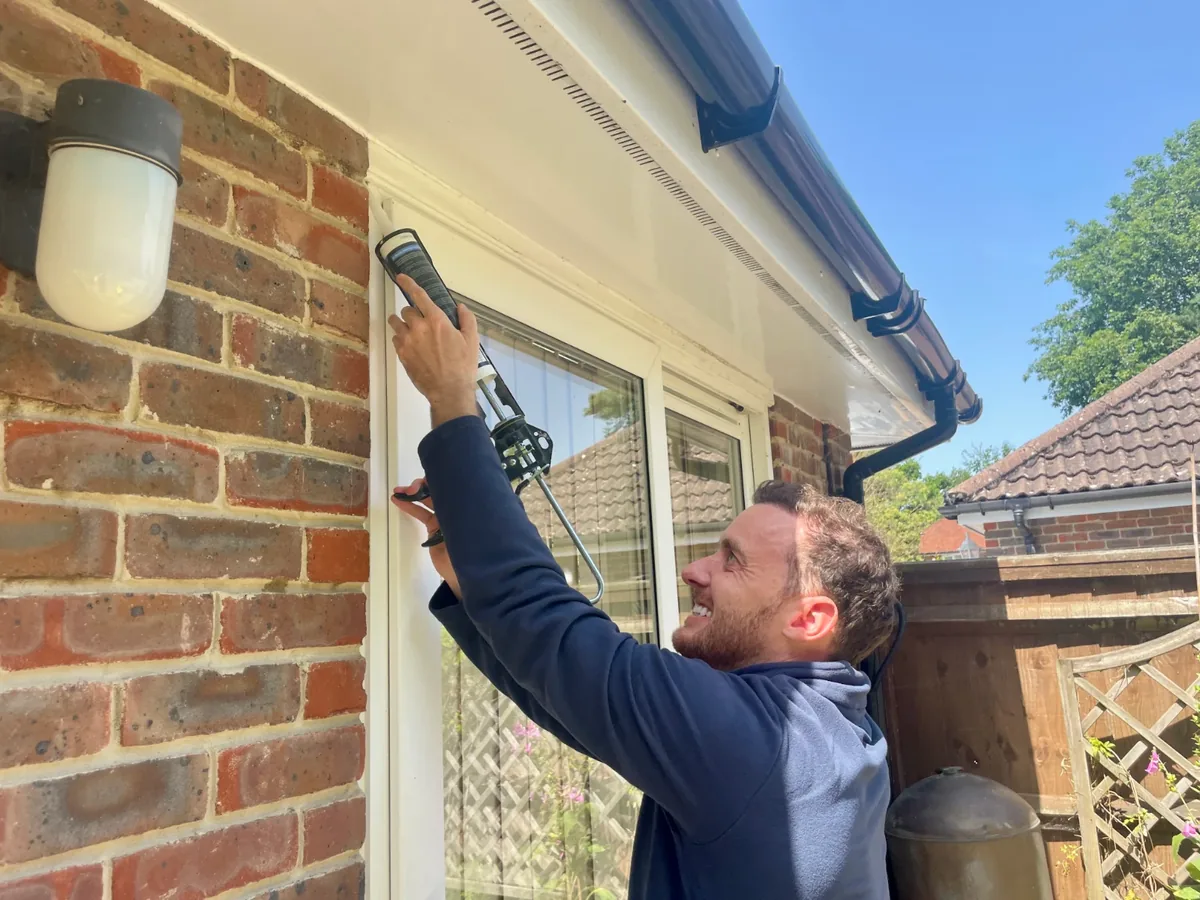
- We mix the sand mastic and apply it by hand, shaping it to the joint.
- The mastic is finished to sit tidily against the stone or brick.
How to prepare
- Tell us about any previous sealing or DIY attempts
- Mention any leaks or damp you’ve noticed
- Mention any tricky access
Getting a quote
For sand mastic in Great Lea Common, call 0345 464 0079 or send us an email. A short description of the job and where it is helps us quote, and you will get a clear quote before we start.
Advice
Windows and doors in Great Lea Common
Rainfall in the South East is lower than in much of the UK, but outside sealant still needs a dry, clean surface, so outdoor work is planned around the forecast. Historic houses like Stratfield Saye House (about 4.3 miles south) are a reminder that the area around Great Lea Common has older buildings as well as new. Where a home is older, older frames set in brick or stone need a sealant that suits them, and sometimes that is traditional sand mastic.
For an older house near a landmark such as St Paul's Church, the windows may be timber, sash or later replacements, and each needs the right sealant against the wall.
Great Lea Common is about 3 miles south of Reading, in West Berkshire. Whether you’re in the middle of Great Lea Common or further out, sand mastic is available for homes and businesses alike, from flats and houses to offices and hotels. Great Lea Common is one of 155 towns and villages in West Berkshire we cover for sand mastic.
Here we cover the RG7 postcode area for sand mastic. If you are just outside Great Lea Common, we cover Three Mile Cross (1 mile south-east), Whitley Wood (1 mile north-east), Ryeish Green (1 mile south-east), Green Park (1 mile north-west) and Shinfield (1 mile east). We also work in nearby towns such as Newbury (15 miles west), Thatcham (12 miles west), Burghfield Common (4 miles west), Speenhamland (15 miles west), Calcot (4 miles north-west) and Shaw (14 miles west).
Landmarks near Great Lea Common
Locally, jobs take us to homes and businesses close to Geoffrey Field Junior School, Ryeish Green School and Pearman's Copse, among other places. The closest station to Great Lea Common is Reading Green Park station, about 1.5 miles north-west. Well-known places in the area include Berkshire Medical Heritage Centre Museum (3 miles north) and Royal Berkshire Hospital (2.9 miles north). Open spaces near Great Lea Common include Fobney Island Wetland Reserve and Longwater.
Looking after it afterwards
No joint lasts for ever, but care makes a real difference. A few tips:
- Plan mastic work ahead of painting
- Leave the new mastic unpainted
- Go gently near the mastic when preparing windows
- Look over the window mastic once a year
Don’t touch or press the mastic while it hardens. It skins over quickly but needs longer to fully harden.
An open joint round the box lets weather through. Left, the gap tends to get bigger.